

Rethinking salt and blood pressure

Written by Kathleen Ferraro (opens in a new tab)
Medically reviewed by Ecler Ercole Jaqua, MD, MBA, DABOM (opens in a new tab) and Eliza Savage, MS, RD, CDN (opens in a new tab)
You’ve probably heard this advice before: “Cut back on salt to lower your blood pressure.” But it’s not that simple. The truth is more nuanced, especially for certain groups of people. For some individuals — particularly active people, those on low-carb diets, or those with certain health conditions — sodium needs may be higher than standard recommendations.
Salt and high blood pressure have been linked in headlines, doctors’ offices, and public health campaigns for decades. The message has been loud and clear: Cut back on salt to protect your heart. As a result, many people have embraced low-sodium diets in the name of health. Note that I didn’t say “healthy” diets. Just low-sodium diets.
While the salt-hypertension connection sounds straightforward, the science isn’t. In fact, the latest research paints a much more nuanced picture, especially for active folks, low-carb eaters, and anyone whose habits don’t follow the “Standard American Diet.” One-size-fits-all salt limits may be outdated, oversimplified, and in some cases, counterproductive.
Below, learn how salt really affects blood pressure, why the old sodium rules are being challenged, and how to assess your own needs based on modern science.
Myth vs. Fact: Does Salt Cause High Blood Pressure?
Salt has long been cast as a cardiovascular villain in fear-based headlines, outdated guidelines, and TikTok trends.
The narrative took hold back to the 1970s, when early observational studiesOpens in a new tab — research that observes natural patterns without controlling variables — suggested a link between salt intake and hypertension, prompting sweeping guidelines for everyone to cut back. For salt-sensative folks, these guidelines weren’t entirely baseless.
But things got muddy when the data was applied as a blanket rule. Instead of identifying who benefits from reducing sodium and who doesn't, public health messaging went all in on low-sodium diets for everyone.
In reality, “there is a great deal of variability in how people respond to dietary sodium,” says Nicholas Norwitz, MD, PhDOpens in a new tab, a clinical research and metabolic health educator and LMNT Partner. “The question we should be asking is: What determines that variability?”
Today, research suggests that genetics, age, ethnicity, baseline blood pressure, kidney function, hormonal status, and certain medical conditions all influence how an individual’s blood pressure responds to dietary sodium, Dr. Norwitz explains.
But even now, evidence shows that the link between salt and high blood pressure isn’t universal — it varies widely from person to person.
So what explains those differences? The answer lies in how your body regulates sodium and fluid balance.
How Salt Affects Blood Pressure, According to the Research
Salt plays a key role in how your body regulates blood pressure, but the relationship isn’t as straightforward as you might think. Let’s break down the science.
Sodium helps regulate the amount of water that stays in and around your cells. When sodium levels are high, your body holds onto more fluid. That extra fluid increases blood volume.
This rise in blood volume directly impacts blood pressure through a process called vascular tone, which is your body’s ability to regulate blood pressure by tightening or relaxing blood vessels. For example, when sodium levels are high, your body may constrict blood vessels to compensate, says Robb WolfOpens in a new tab, former research biochemist, bestselling author, and co-founder of LMNT.
People who are salt-sensitive experience a larger rise in blood pressure when they eat sodium, says Wolf.
That doesn’t mean everyone reacts to sodium the same way.
- People who are salt-sensitive: Experience a larger rise in blood pressure when they eat sodium.
- People who are salt-resistant (or salt-insensitive): Can consume more sodium without much change in blood pressure, as their blood vessels relax and adapt more easily.
FactorsOpens in a new tab that can contribute to salt sensitivity include:
- Insulin resistance
- Kidney function
- Overall diet
Because salt sensitivity varies from person to person, “each patient needs to be evaluated as an individual,” says Cynthia Thurlow, NPOpens in a new tab, a nutrition educator and nurse practitioner. Looking at your overall lifestyle, along with a basic physical exam, can help your health care provider decide whether you need to limit your salt intake or not, she explains.
What modern research shows: Mechanisms and nuance
Recent research helps make sense of these contradictions. Over the past decade, scientists have uncovered key nuances showing that your body’s response to salt depends on more than just how much you consume:
- Insulin sensitivity, kidney function, and diet quality influence salt response: ResearchOpens in a new tab shows salt sensitivity — when your blood pressure reacts more strongly to sodium — is linked to insulin resistance. Insulin helps move sugar from your bloodstream into your cells for energy. When your cells don’t respond properly, sugar builds up in your blood instead of being used as fuel. Kidney health and diet can also affect your body’s response to salt.
- Salt-sensitive and salt-resistant individuals respond differently: For salt-sensitive folks, sodium can trigger blood vessels to constrict, raising blood pressure. Those who are salt-resistant (or salt-insensitive) can consume more sodium without much change in blood pressure, as their blood vessels relax and adapt more easily.
- Universal sodium restrictions don’t work for everyone: Research reviewsOpens in a new tab suggest both too high and too low sodium intakes can raise your risk for cardiovascular problems. But in many of these studies, other factors — like overall diet quality, ultra-processed food intake, low potassium levelsOpens in a new tab, or existing health conditions — may have contributed to those outcomes. It’s often the combination of these factors that increases risk, not sodium alone.
- For some individuals, low sodium intake may backfire: People who are physically activeOpens in a new tab or follow low-carb or minimally processed diets often excrete more sodium through sweat and urine. Because they tend to retain less sodium overall, restricting sodium can cause symptomsOpens in a new tab like fatigue, headaches, or muscle crampsOpens in a new tab. In these cases, increasing sodium may be necessary to maintain proper fluid balance and feel their best.
What the studies say: Real-world findings
Salt affects blood pressure in two ways:
- Short-term: Eating a salty meal temporarily raises blood pressure through increased fluid in your blood vessels — similar to when you're dehydratedOpens in a new tab. This usually balances out within hours or daysOpens in a new tab.
- Long-term: Chronic high blood pressure develops gradually over time as multiple factors — like poor sleep, inactivity, ongoing stress, and insulin resistance — compound.
The research around daily sodium intake patterns and blood pressure is nuanced:
- One reviewOpens in a new tab found that when people reduced their sodium for at least four weeks, their blood pressure dropped whether they had high blood pressure or not.
- Another studyOpens in a new tab of over 100,000 people found that those eating less than 3 grams of sodium per day had higher risks of heart problems — similar to people eating more than 6 grams daily.
So, what does that mean? That sodium intake needs are unique to YOU and depend on your overall health and lifestyle. Some people who need more salt, not less, often include:
- Those on low-carbOpens in a new tab or whole-foodOpens in a new tab diets (these lower insulin, which makes your body lose more sodium).
- Regular exercisersOpens in a new tab (especially in hot or humid conditions).
- People who sweat excessively.
- Those exposed to high altitudes.
"If you don't replace the sodium you lose, it can affect fluid balance and blood pressure," says Wolf.
On the other hand, for those with heart failure, kidney disease, liver disease, or edema, sodium restriction may be necessary.
It's important to assess your individual sodium needs by speaking with a healthcare provider, such as a registered dietitian or physician to find out what makes sense. Increasing or decreasing your salt intake isn’t automatically going to be “better.”
The takeaway: Salt isn’t inherently harmful, and for some people, it’s essential. Like most things in health, it’s all about context and balance.

Sea Salt vs. Table Salt: Any Difference for Blood Pressure?
The short answer: Not really.
“There’s probably not a meaningful difference between sea salt and table salt when it comes to blood pressure, even though sea salt tends to include more trace minerals like calcium, albeit in very small amounts,” says Dr. Norwitz. The key word is trace — the mineral content is easily obtainable through a diet high in whole foods.
Despite marketing claims, no salt is “cleaner” or “healthier” than another. Unless your doctor has prescribed a low-sodium option, the best salt is the one you enjoy using — and for most metabolically healthy people, that probably means getting more sodium, not less.
More important than the type of salt you choose is how much sodium you’re consuming and whether it’s balanced with other key electrolytesOpens in a new tab, says Dr. Norwitz. That balance matters far more for blood pressure than whether your salt came from the sea or a shaker.
The U.S. Dietary Guidelines recommend an Adequate Intake (AI) of 1.5 grams per day, with an upper limit of 2.3 grams per day for adults.
“The American Heart AssociationOpens in a new tab even reports the ‘optimal goal’ should be no more than 1.5 grams per day,” says Dr. Norwitz. “This recommendation is not suitable for everybody. For example, athletes or active people who lose a lot of electrolytes in sweat likely benefit from more — potentially far more — than the RDA.“
That’s why LMNTOpens in a new tab’s formulation pairs sodium — sourced from natural salt deposits in the U.S. using steam evaporation without further refining, demineralizing, or chemical processing — with potassium and magnesiumOpens in a new tab to support optimal hydration, fluid balance, and blood pressure regulation.
When to Reduce Salt — And When You Might Not Need To
Whether you should limit or increase your salt intake depends on your individual health context. Here’s the breakdown.
When (and why) salt reduction can help
Salt needs are highly individual, so it's best to consult a healthcare provider before making any changes. But here are a few scenarios where sodium restriction may make sense:
- Hypertension: For some people with hypertension, reducing sodium may modestly lower blood pressure — but it’s rarely the whole solution. Wolf explains that changes in sodium alone, whether adding or restricting, usually have limited impact. “One must address the underlying insulin resistance, which is often the driver of hypertension,” he says.
- Salt sensitivity: For salt-sensitive people, sodium can cause a bigger spike in blood pressure. But it’s not just about salt. Thurlow says poor metabolic health, insulin resistance, and lifestyle habits also play a role. It’s about how your body handles salt — not just how much you consume.
- Kidney disease: Damaged kidneysOpens in a new tab have a harder time filtering excess sodium from the blood. This can lead to fluid retention and higher blood pressure. But even then, clinicians often pay closer attention to potassiumOpens in a new tab, says Wolf, because impaired kidney function can cause potassium to build upOpens in a new tab in the blood to dangerous levels.
- Highly processed diets: If your diet includes a lot of packaged or processed foods, you’re likely getting plenty of sodium already — possibly too much. Thurlow suggests swapping ultra-processed items for nutrient-dense, minimally processed foods to naturally reduce added sodium while improving your metabolic health, which often has a greater impact on blood pressure than salt alone.
When you might need more salt
In certain situations, a moderate-to-high salt intake isn’t just safe — it’s essential. These scenarios typically result from higher sodium loss or electrolyte demands.
According to the experts, salt may be especially important for those who are:
- Active and sweat often: Physical activity (especially in hot, humid, or high-altitude environments) causes the body to lose sodium through sweat, increasing the need for replacement, says Wolf.
- Following a low-carb or minimally processed diet: These diets lower insulin levels, which makes your body flush out more sodium, says Wolf. Since you’re also eating fewer processed foods (which are typically high in sodium), it’s easy to fall short, so added salt or electrolytes may be necessary.
- Navigating hormonal conditions affecting aldosteroneOpens in a new tab levels (e.g., Addison’s disease or adrenal insufficiency): These individuals may need higher sodium under medical supervision, in order to avoid low blood volume and symptomsOpens in a new tab like dizziness and fatigue.
- Breastfeeding or pregnantOpens in a new tab: Lactation increases fluid and electrolyte requirements, which is why breastfeeding parents can benefit from higher sodium intakeOpens in a new tab (as long as they don’t have a medical condition that requires limiting salt), says Thurlow.
- Living with POTSOpens in a new tab or dysautonomia: These nervous system disorders affect blood pressure regulation, so additional sodium can improve symptoms like lightheadedness or fatigue, says Thurlow.
The bottom line: Salt intake isn’t one-size-fits-all. Your ideal intake depends on your body, your health conditions, and your lifestyle.
The Bigger Issue: Processed Foods and Sodium Content
The majority of sodium in the modern diet doesn’t come from salting your food at the table or drinking electrolyte water — it comes from ultra-processed foodsOpens in a new tab (think fast food and packaged snacks).
In addition to sodium, these foods are often loaded with added sugars, preservatives, and saturated and trans fats. These ingredients can negatively impact metabolic healthOpens in a new tab and contribute to conditions like hypertension, diabetes, and cardiovascular disease.
In contrast, sodium from whole foods and clean electrolyte products can support your wellbeing, says Thurlow.
That’s why the sodium conversation needs to shift. It’s not just about how much you’re getting — it’s about where it’s coming from, what it’s paired with, and your overall lifestyle, says Thurlow.
Sodium from a whole-food, nutrient-dense diet can support hydration, circulation, and performance. That’s a different story than sodium bundled with refined carbs, unhealthy fats, and added sugars.
Takeaways for Managing Blood Pressure Holistically
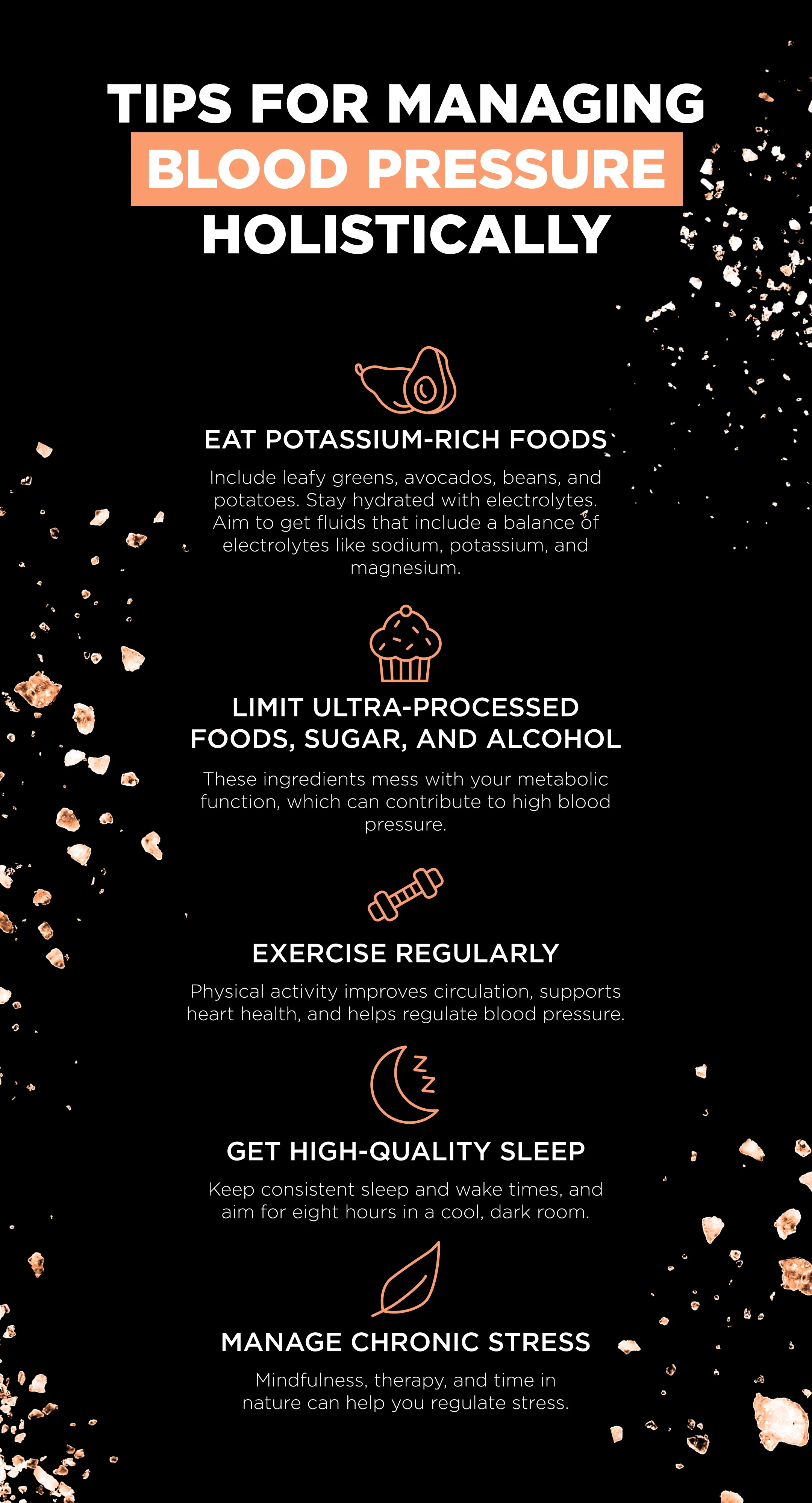
Salt matters. But it’s just one piece of the puzzle. A whole-body approach can be far more effective (and sustainable) than solely modifying sodium intake. Here’s where to start:
- Eat potassium-rich foods: Potassium helps counterbalance sodiumOpens in a new tab and relax blood vessels, which can help regulate blood pressure. Fill your plate with sources of potassiumOpens in a new tab, like leafy greens, avocados, beans, and potatoes.
- Stay hydrated with electrolytes: Water alone isn’t always enough to prevent dehydrationOpens in a new tab. Aim to get fluids that include a balance of electrolytesOpens in a new tab like sodium, potassium, and magnesium, especially if you’re active or sweat often.
- Limit ultra-processed foods, sugar, and alcohol: These ingredients mess with your metabolic function, which can contribute to high blood pressure, says Thurlow.
- Exercise: Regular physical activityOpens in a new tab improves circulation, supports heart health, and helps regulate blood pressure.
- Sleep: Consistent, high-quality sleepOpens in a new tab is essential for supporting cardiovascular health.
- Manage stress: Chronic stressOpens in a new tab can increase your blood pressure. Whether it’s mindfulness, therapy, time in nature, or something else, find practices that help you regulate.
Key Takeaways
- Sodium is essential. Your body needs it to regulate fluids, nerves, and muscles. The issue isn’t sodium itself, but the processed food environment where it’s overused.
- The salt–blood pressure link isn’t one-size-fits-all. Early studies led to broad “cut back on salt” guidelines, but modern research shows that sodium affects people differently.
- Individual factors shape sodium needs. Genetics, age, kidney function, hormones, insulin sensitivity, and overall metabolic health all influence how your body responds to sodium.
- Salt sensitivity explains varied reactions. Some people experience a stronger blood pressure rise from sodium, while others are salt-resistant and see little to no change.
- Most excess sodium comes from processed foods that also contain refined carbs, added sugars, and unhealthy fats — a combination that can compound and negatively impact metabolic health overtime.
- Some people need more sodium, not less. Active individuals, low-carb eaters, and heavy sweaters lose more sodium and may need to replace it to avoid fatigue, cramps, and dehydration. There are some health conditions that require a higher sodium intake, too.
- To support healthy blood pressure, eat a diet that includes potassium-rich foodsOpens in a new tab, stay hydrated, sleep well, manage stress, and move regularly.
Frequently Asked Questions (FAQs)
Does salt raise blood pressure quickly?
Folks who are salt-sensitive and eat a salty meal may experience an increase in blood pressure within hours. But for those who are salt-resistant (or salt-insensitive), sodium may have little to no short-term effect on blood pressure. The response depends on how well your body regulates fluid balance and vascular tone, which largely depends on genetics, age, kidney function, hormones, insulin sensitivity, and overall metabolic health.
Does cutting out salt really lower blood pressure?
It can, but the effect is highly individual. Some studies show that reducing sodium lowers blood pressure slightly, especially in salt-sensitive individuals. But for many people, improving overall metabolic health (through diet, movement, stress management, and sleep) may have a much greater impact than cutting salt alone. In fact, low sodium intake may even backfire for some people, especially those who are active, follow low-carb or minimally processed diets, or lose a lot of sodium through sweat. These individuals may need more sodium to maintain proper hydration, circulation, and performance.
What are the signs of too much salt?
Signs of excess sodium may include:
- Swelling in the hands, feet, or face (from fluid retention)
- Feeling bloated or puffy
- Excessive thirst
- Headaches
- High blood pressure
What is the number one food that causes high blood pressure?
No single food directly causes high blood pressure. However, diets high in ultra-processed foods (fast food, processed meats, sugary drinks) are strongly associated with hypertension largely because these foods combine ingredients that promote poor metabolic health, such as refined carbohydrates, added sugars, and industrial fats, while providing little nutritional value.