

Sodium and bone health: A nuanced story of balance, not elimination

Written by Kathleen Ferraro (opens in a new tab)
Medically reviewed by Ecler Ercole Jaqua, MD, MBA, DABOM (opens in a new tab) and Eliza Savage, MS, RD, CDN (opens in a new tab)
<p><strong>Ever heard that salt leaches calcium from bones? In reality, it’s way more nuanced than that. For active, well-nourished individuals, sodium isn’t the enemy of bone health — it actually plays a crucial role in maintaining it. Sodium helps regulate key hormones that control calcium balance and bone remodeling. It also supports kidney function and mineral retention. Let’s unpack the science so you can hydrate (and salt your food) with confidence.</strong></p><p>Bone health is a growing priority — not just for menopausal women and older adults, but for anyone thinking about longevity. Athletes, low-carb eaters, and wellness-minded folks are increasingly tuned into how lifestyle and diet can shape long-term skeletal strength. </p><p>At the same time, many are also increasing their sodium intake to support hydration, performance, or low-carb needs and wondering: Does salt weaken my bones?</p><p>It’s a fair question. For decades, public health messaging warned us that sodium causes calcium loss, which could increase fracture risk and contribute to osteoporosis. But like many nutrition narratives, that one got boiled down to an oversimplified headline.</p><p>Here’s what the current science actually says, and what it means for your bones.</p><h2>The Sodium-Calcium Connection: What the Science Says</h2><p>To understand how sodium affects bone health, we have to start with the kidneys, your body’s mineral gatekeepers. </p><p>These vital organs don’t just filter waste; they regulate how much of key minerals like sodium and calcium your body retains or excretes. And that’s where the salt-and-bone story begins.</p><p>Sodium is an <a href="https://www.ncbi.nlm.nih.gov/books/NBK541123/" rel="noopener noreferrer" target="_blank">electrolyte</a> that helps regulate fluid balance, nerve function, and muscle contraction. </p><p>Calcium, meanwhile, is a key structural mineral that keeps bones and teeth strong, while also supporting muscle and nerve activity. </p><p>Both minerals are essential, and your kidneys help control how much of each stays in your body or gets flushed out.</p><p>Older studies observed that when people ate more sodium, they also lost more calcium through their urine. This led researchers to speculate whether a high-salt diet might cause the body to pull calcium from the bones, potentially weakening them over time. </p><p>Here are two key examples: </p><ul><li><strong>High sodium and low calcium intake:</strong> One <a href="https://pmc.ncbi.nlm.nih.gov/articles/PMC3257722/" rel="noopener noreferrer" target="_blank">study</a> found that women who ate more salt lost more calcium in their urine, especially if they weren’t getting enough calcium through their diet. This combination — high sodium paired with low calcium intake — was also linked to weaker hip bones. </li><li><strong>High sodium and high calcium intake: </strong>Another small <a href="https://onlinelibrary.wiley.com/doi/full/10.1359/jbmr.080408" rel="noopener noreferrer" target="_blank">study</a> of 11 postmenopausal women also found that eating more salt led to greater calcium loss through urine, even when the women were eating plenty of calcium. Salt didn’t change how well the women absorbed calcium, but it did tip the balance toward bone loss when sodium was high, even with plenty of calcium. And when calcium was low, they lost bone no matter how much salt they ate.</li></ul><p>But that’s not the whole story.</p><p>“Those studies didn’t consider the whole picture,” says <a href="https://drmindypelz.com/about/" rel="noopener noreferrer" target="_blank">Mindy Pelz</a>, DC, a women’s health and fasting coach, and LMNT Partner. “They missed key cofactors like magnesium, potassium, and even overall protein intake, all of which affect how your body builds and maintains bone. And they didn’t look at what happens on the other end when you go too low in sodium.”</p><p>In fact, <strong>newer studies show that extreme sodium restriction actually triggers calcium dumping and hormone imbalances that harm bone health even more</strong> (more on that research in a moment), according to Dr. Pelz.</p><p>Ultimately, balance is key. “It’s not about cutting sodium out, it's about hitting the <a href="https://quiz.drinklmnt.com/?_gl=1*1anasf9*_gcl_aw*R0NMLjE3NTAzNTE3MDMuQ2p3S0NBandnYl9DQmhCTUVpd0EwcDNvT0JIVS1xX3pBRnFGaDZMM0llTzVZXzRzQ2tacC1TVWpsc2hFUWZtRVVXMWFfdFFiYzJiVE9Sb0NMc1FRQXZEX0J3RQ..*_gcl_au*NTg4NTEyNjU5LjE3NDg0NTI5NjU.*_ga*MzY1MTAyMDk1LjE3NDA1OTkxMTY.*_ga_BKZV7MVXM7*czE3NTMyODQyNDIkbzUyJGcwJHQxNzUzMjg0MjUzJGo0OSRsMCRoMA.." rel="noopener noreferrer" target="_blank">right level for your body</a> to function optimally and protect your bone density as you age,” says Dr. Pelz.</p><p>In other words,<strong> sodium isn’t inherently bad for your bones, and cutting back too much can actually backfire</strong>. What matters most is your holistic nutrient intake. Other factors, like regular strength training and impact sports (like jogging), can also help prevent <a href="https://www.ncbi.nlm.nih.gov/books/NBK279073/" rel="noopener noreferrer" target="_blank">loss of bone density</a>, regardless of the cause.</p><h2>Does Sodium Leach Calcium from Bones?</h2><p>Short answer: No, sodium does not leach calcium from your bones. This is one of the most common concerns about salt and bone health, and it's based on a kernel of truth that’s often misunderstood.</p><p>Remember, the idea that sodium leaches calcium from bones comes from older studies that suggested a link between high sodium intake and increased calcium excretion in urine. </p><p>But just because more calcium shows up in your urine doesn’t automatically mean you’re <a href="https://pmc.ncbi.nlm.nih.gov/articles/PMC5514609/" rel="noopener noreferrer" target="_blank">losing bone mass</a>. </p><p><strong>Instead, “when you’re too low in sodium, your kidneys kick into overdrive trying to conserve it, often at the expense of calcium,” says Dr. Pelz. “That means more calcium gets flushed out in your urine, which can eventually pull calcium from your bones.”</strong></p><p>So while low sodium levels can indirectly lead to calcium loss, the idea that eating salt directly causes bone loss is a myth.</p><h2>Low Sodium and Calcium Deficiency: A Hidden Risk?</h2><p>Sodium often gets a bad rap, but when it comes to bone health, too little can quietly do more harm than good. That’s because<a href="https://pmc.ncbi.nlm.nih.gov/articles/PMC9862583/" rel="noopener noreferrer" target="_blank"> sodium plays a key role in maintaining your body’s mineral balance</a> and <a href="https://www.ahajournals.org/doi/10.1161/HYPERTENSIONAHA.113.02253" rel="noopener noreferrer" target="_blank">regulating the hormones that control how calcium</a> is used and stored.</p><p>Here’s how it works.</p><h3>Step 1: Sodium drops, calcium spills</h3><p>Your body tightly regulates sodium levels to keep critical systems running. So when sodium levels dip too low, your kidneys compensate by retaining sodium. But there’s a catch: To do that, they may excrete more calcium.</p><p>“If you're eating a very low-sodium diet thinking it’s good for your health, you may actually be weakening your bones without realizing it,” says Dr. Pelz.</p><p>The calcium lost through urine doesn’t always get replaced right away, especially if your diet is also low in calcium. That’s when your body calls in hormonal reinforcements.</p><h3>Step 2: Hormones step in to correct the imbalance</h3><p>Your body relies on hormones — chemical messengers — to manage mineral levels behind the scenes. When sodium drops and calcium follows, one key player is activated: the parathyroid hormone (PTH).</p><p>“When sodium levels drop too low, you set off a domino effect,” says Pelz. “Your kidneys start spilling calcium. That drop in calcium triggers your parathyroid glands to release parathyroid hormone to bring blood calcium back up. But guess where it gets that calcium? Your bones.”</p><p><a href="https://www.ncbi.nlm.nih.gov/books/NBK499940/" rel="noopener noreferrer" target="_blank">Parathyroid hormone</a> (PTH) is one of your body’s main regulators of calcium. When blood calcium dips too low, it helps increase blood calcium by enhancing absorption from the gut, promoting bone resorption, and reducing urinary calcium excretion — though this can come at the expense of bone mineral stores.</p><p>TL:DR: <strong>Cutting too much sodium from your diet can spark a hormone response (with PTH) that pulls calcium straight from your bones.</strong></p><p>Adequate sodium intake may help reduce compensatory elevations in PTH by supporting calcium retention. “When you get enough sodium,” says Dr. Pelz, “your kidneys retain calcium more efficiently, which reduces the need for PTH to step in and start pulling calcium from your bones.”</p><p>But what counts as <em>too little</em> sodium? That’s where things get murky and often misunderstood. <strong>While the </strong><a href="https://science.drinklmnt.com/electrolytes/the-fdas-misguidance-on-sodium" rel="noopener noreferrer" target="_blank"><strong>FDA</strong></a><strong> sets 1,500 mg/day as the adequate intake (AI) for sodium, this is often misinterpreted as optimal. In reality, that’s a bare minimum </strong>— and for many people, especially those on whole-food or low-carb diets, it may be too low to support healthy blood volume, nerve signaling, and <a href="https://science.drinklmnt.com/electrolytes/hydration-and-athletic-performance/" rel="noopener noreferrer" target="_blank">performance</a>.</p><p>Go too low, and the <a href="https://science.drinklmnt.com/electrolytes/is-sodium-good-or-bad" rel="noopener noreferrer" target="_blank">body pushes back</a>: fatigue, dizziness, and even compensatory mechanisms like increased <a href="https://science.drinklmnt.com/electrolytes/electrolytes-and-heart-health" rel="noopener noreferrer" target="_blank">heart rate and blood pressure</a> can kick in to preserve sodium balance.</p><p>And in extreme cases, critically low sodium can be <a href="https://science.drinklmnt.com/electrolytes/hyponatremia-signs-and-symptoms" rel="noopener noreferrer" target="_blank">fatal</a>. That’s why standard IV saline contains 9,000 mg of sodium per liter — a concentration administered safely in hospitals millions of times per day. We’re not suggesting everyone needs that much, but it’s a powerful reminder that <strong>sodium itself isn’t inherently harmful. Context matters.</strong></p>

<h3>Step 3: Other hormones that matter</h3><p>While sodium influences certain hormones like PTH and aldosterone, it’s not the only factor at play.</p><p>According to <a href="https://dramie.com/meet-the-team/" rel="noopener noreferrer" target="_blank">Amie Hornaman, DCN</a>, a doctor of clinical nutrition and LMNT Partner, bone health is regulated by a complex network of hormones, including: </p><ul><li><strong>Thyroid hormones</strong> help regulate calcium and phosphorus metabolism, both of which are essential for bone mineralization. “This is why maintaining thyroid levels in an optimal, not just ‘normal,’ range is essential for protecting long-term skeletal health,” says Dr. Hornaman. </li><li><a href="https://www.ncbi.nlm.nih.gov/books/NBK470339/" rel="noopener noreferrer" target="_blank"><strong>Aldosterone</strong></a>, produced by the adrenal glands, controls how your body manages sodium and potassium. </li><li><a href="https://www.ncbi.nlm.nih.gov/books/NBK538260/" rel="noopener noreferrer" target="_blank"><strong>Estrogen</strong></a> helps slow bone breakdown</li><li><a href="https://www.ncbi.nlm.nih.gov/books/NBK558960/" rel="noopener noreferrer" target="_blank"><strong>Progesterone</strong></a> activates the cells that form new bone.</li></ul><p>So instead of overindexing on sodium intake, make sure you’re paying attention to the broader picture of hormones that govern your mineral balance.</p>

<h2>What New Research Shows About Sodium and Bone Density</h2><p>While older studies raised concerns about salt increasing calcium loss, newer research tells a more complete — and often more reassuring — story.</p><ul><li><strong>Sodium is linked to bone health: </strong>A 2024 <a href="https://journals.lww.com/md-journal/fulltext/2024/12130/relationship_between_multi_nutrient_intake_and.55.aspx" rel="noopener noreferrer" target="_blank">analysis</a> of 10,355 adults found that higher dietary sodium intake was linked to greater femur bone density and lower rates of osteopenia and osteoporosis. The key? This link emerged once researchers adjusted for other key factors like age, body mass index, protein consumption, and intake of other minerals. In other words, when you examine sodium in context with other nutrients, it often correlates with stronger bones, not weaker ones.</li><li><strong>Overall electrolyte balance matters:</strong> Another 2022 <a href="https://pmc.ncbi.nlm.nih.gov/articles/PMC8955583/" rel="noopener noreferrer" target="_blank">review</a> focusing on endurance athletes found that while both too high and very low sodium intakes can pose health issues, the real concern is electrolyte imbalance. That’s because sodium intake plays a key role in supporting both <a href="https://science.drinklmnt.com/electrolytes/hydration-and-athletic-performance/" rel="noopener noreferrer" target="_blank">hydration and performance</a>.</li><li><strong>Other nutrients play a role in bone health: </strong>Sodium’s impact on bone health also depends on other nutrients in the diet. A 2019 <a href="https://pmc.ncbi.nlm.nih.gov/articles/PMC6901417/" rel="noopener noreferrer" target="_blank">review</a> found that adequate protein, vitamin D, and overall energy intake also contribute to bone strength and preservation.</li></ul><p>So why does today’s research paint a different picture? <strong>Many early sodium studies were observational, meaning they spotted patterns, not direct causes. And they didn’t always account for other important bone-health factors, like magnesium, potassium, protein intake, or physical activity</strong>, says Dr. Pelz. Observational studies can reveal associations but can’t prove that sodium intake directly causes bone loss, since many confounding variables — like hydration status, diet quality, or physical activity — may not have been controlled.</p><p>That’s why more recent, better-controlled studies carry more weight in today’s recommendations.</p>
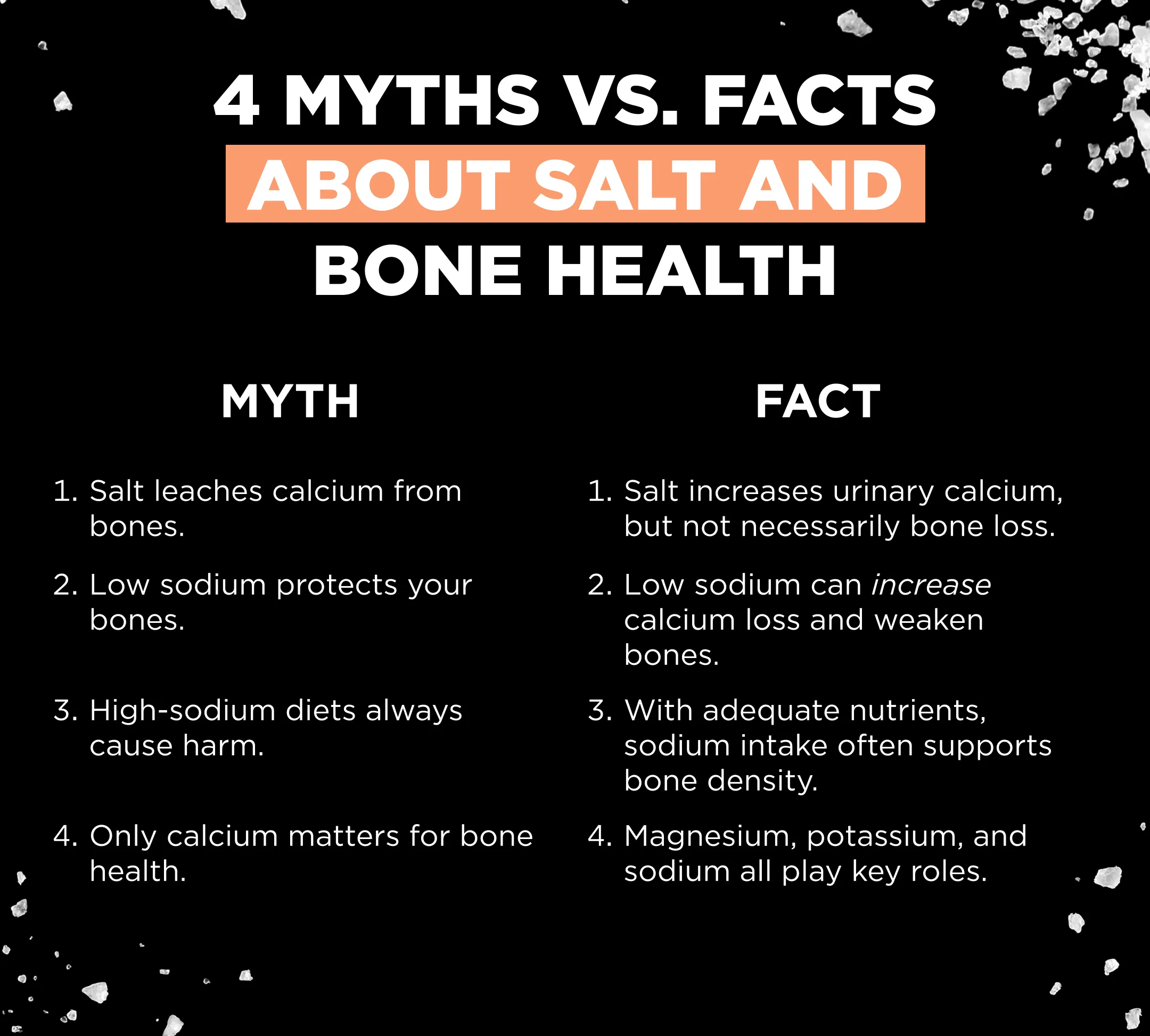
<h2>Who’s Really at Risk for Osteoporosis?</h2><p>While sodium often gets the blame, many other factors have a stronger and more direct impact on bone loss.</p><p>According to research, these factors play a major role in osteoporosis risk:</p><ul><li><strong>Low calcium, vitamin D, and magnesium intake:</strong> These nutrients are essential for bone formation and maintenance. Without enough calcium, your body may pull it from your bones to maintain blood levels. <a href="https://pmc.ncbi.nlm.nih.gov/articles/PMC2669834/" rel="noopener noreferrer" target="_blank">Vitamin D helps with calcium absorption</a>, and without it, even a high-calcium diet can fall short. “Magnesium, in particular, helps activate vitamin D and regulate calcium absorption,” adds Dr. Hornaman. </li><li><strong>Sedentary lifestyle:</strong> Exercise is one of the most effective ways to <a href="https://pmc.ncbi.nlm.nih.gov/articles/PMC6197664/" rel="noopener noreferrer" target="_blank">maintain bone density</a>. A lack of regular movement — especially resistance or (counter-intuitively) high-impact exercise like jogging or jump roping — can accelerate bone loss over time.</li><li><a href="https://science.drinklmnt.com/electrolytes/electrolytes-hormone-balance-for-women" rel="noopener noreferrer" target="_blank"><strong>Hormonal imbalances</strong></a><strong> (especially post-menopause):</strong> “Low estrogen in women, especially after menopause, leads to faster bone breakdown,” says Dr. Hornaman. “Women who are chronically low in progesterone, which is very common in perimenopause, can also lose bone density more quickly.” </li><li><strong>Chronic low protein intake:</strong> “A low-protein diet makes it harder for your body to build the collagen matrix your bones need to stay strong,” says Dr. Pelz.</li><li><strong>Ultra-processed diets:</strong> Highly processed foods (like baked goods, packaged snacks, and candy) are often low in key bone-supporting nutrients like calcium, magnesium, potassium, and vitamin D. <a href="https://www.mdpi.com/2072-6643/17/7/1188" rel="noopener noreferrer" target="_blank">Research</a> shows that an imbalanced diet like this is linked to bone health conditions like osteoporosis.</li></ul><h2>Foods and Habits That May Harm Bone Health</h2><p>When it comes to protecting your bones, it’s not just about what you include in your diet — it’s also about what to limit. Certain foods and lifestyle habits can interfere with mineral balance, hormone regulation, or bone remodeling. Here are some of the biggest culprits:</p><ul><li><strong>Ultra-processed foods:</strong> Remember, processed foods lack the vitamins and minerals essential for bone health. These foods also tend to be high in additives and low in protein and fiber.</li><li><strong>Soda and phosphate additives:</strong> Colas and other soft drinks often contain <a href="https://pmc.ncbi.nlm.nih.gov/articles/PMC7071508/" rel="noopener noreferrer" target="_blank">phosphoric acid</a>, which is linked to decreased bone density, osteoporosis, and fractures.</li><li><strong>Excessive alcohol and smoking:</strong> <a href="https://pmc.ncbi.nlm.nih.gov/articles/PMC8210532/" rel="noopener noreferrer" target="_blank">Research</a> shows that people who drink alcohol and smoke have a higher risk of osteoporosis compared to those who abstain from both.</li><li><strong>Long-term corticosteroid use:</strong> <a href="https://pmc.ncbi.nlm.nih.gov/articles/PMC8259736/" rel="noopener noreferrer" target="_blank">Research</a> suggests corticosteroid use (example: Cortisone) can weaken bones by interfering with how your body builds and maintains bone tissue.</li></ul><h2>How to Support Bone Health — Without Fearing Salt</h2><p>Supporting your bones isn’t about cutting salt. It’s about building a strong foundation with the right nutrients and habits. Here’s how to do it:</p><ul><li><strong>Stay hydrated with electrolytes:</strong> “Maintaining healthy electrolyte levels, especially magnesium, sodium, and potassium, supports proper mineralization and overall bone health,” says Dr. Hornaman.</li><li><strong>Eat potassium- and magnesium-rich foods: </strong>These key electrolytes (found in LMNT) help maintain overall mineral balance and support bone remodeling.</li><li><strong>Get enough calcium and vitamin D:</strong> Vitamin D helps your body absorb calcium (don’t forget: magnesium helps activate Vitamin D), and they work together to build and maintain strong bones. </li><li><strong>Strength-train regularly:</strong> “If you’re not lifting heavy things or walking with resistance (like a weighted vest), your bones aren't getting the signals they need to grow denser,” says Dr. Pelz. “Movement matters, especially resistance-based movement in your postmenopausal years.”</li></ul><h2>Key Takeaways</h2><ul><li><strong>Sodium doesn’t automatically weaken bones.</strong> While older studies linked high salt intake to calcium loss, newer research shows the story is more nuanced.</li><li><strong>The real issue is balance.</strong> Yes, sodium can increase calcium loss in urine. But that doesn’t mean it harms your bones, especially if your diet supplies adequate calcium and supportive nutrients. On the flip side, very low sodium can be just as harmful, disrupting hormones like PTH and triggering your body to pull calcium from your bones.</li><li><strong>Your lifestyle matters more than your salt intake alone.</strong> Your overall lifestyle and dietary habits have a much greater impact on bone health than sodium intake in isolation. Getting enough calcium, vitamin D, protein, magnesium, and potassium, along with regular resistance-based exercise, does far more to support strong bones.</li></ul><h2>FAQs: Sodium and Bone Health</h2><h3>Does sodium affect bone health?</h3><p>It can, but it’s nuanced. While high sodium can increase calcium loss in urine, that doesn’t automatically lead to weaker bones, especially if your diet includes enough calcium and other key nutrients. On the flip side, too little sodium can disrupt hormone function and trigger calcium loss from bones. </p><h3>What is the fastest way to increase bone density?</h3><p>There’s no instant fix, but dialing in a few key habits can support the process:</p><ul><li>Do regular resistance and weight-bearing exercise</li><li>Get enough calcium and vitamin D</li><li>Ensure adequate protein intake</li><li>Stay hydrated with electrolytes, specifically sodium, potassium, and magnesium</li></ul><h3>Is salt good for bone healing?</h3><p>While it doesn’t directly rebuild bone, getting enough sodium helps your body retain calcium and regulate the hormones that drive bone maintenance and repair. Bone healing depends more directly on calcium, vitamin D, protein intake, and overall metabolic health — but sodium helps maintain the hormonal environment necessary for that process.</p><h3>Does low sodium cause bone loss?</h3><p>Very low sodium levels can contribute to bone loss by disrupting hormone regulation — particularly PTH and aldosterone — which control calcium retention. When sodium is too low, the body may excrete more calcium in the urine and pull calcium from bones to maintain blood levels. Over time, this can weaken bone structure, especially if calcium intake is also low.</p><h3>What is the role of sodium in bones?</h3><p>Sodium helps regulate the hormones that control calcium balance and bone remodeling, like PTH and aldosterone. It also supports kidney function and mineral retention. While sodium isn’t a structural part of bone like calcium, it plays an essential behind-the-scenes role in keeping your bones strong and your mineral system in balance.</p>