
How to Adjust Your Hydration as Running Volume Increases

Written by Caitlin Carlson (opens in a new tab)
Medically reviewed by Ecler Ercole Jaqua, MD, MBA, DABOM (opens in a new tab)
Lots of runners assume hydration scales with mileage. Run 20% more, drink 20% more. Sounds reasonable.
But hydration doesn't work like a gas tank. As training volume increases, your fluid and sodium needs can rise faster than your mileage. Or slower. It depends on how hard you're running, how long you're out there, how well you've adapted to the heat, and other variables that don't show up in your Strava summary.
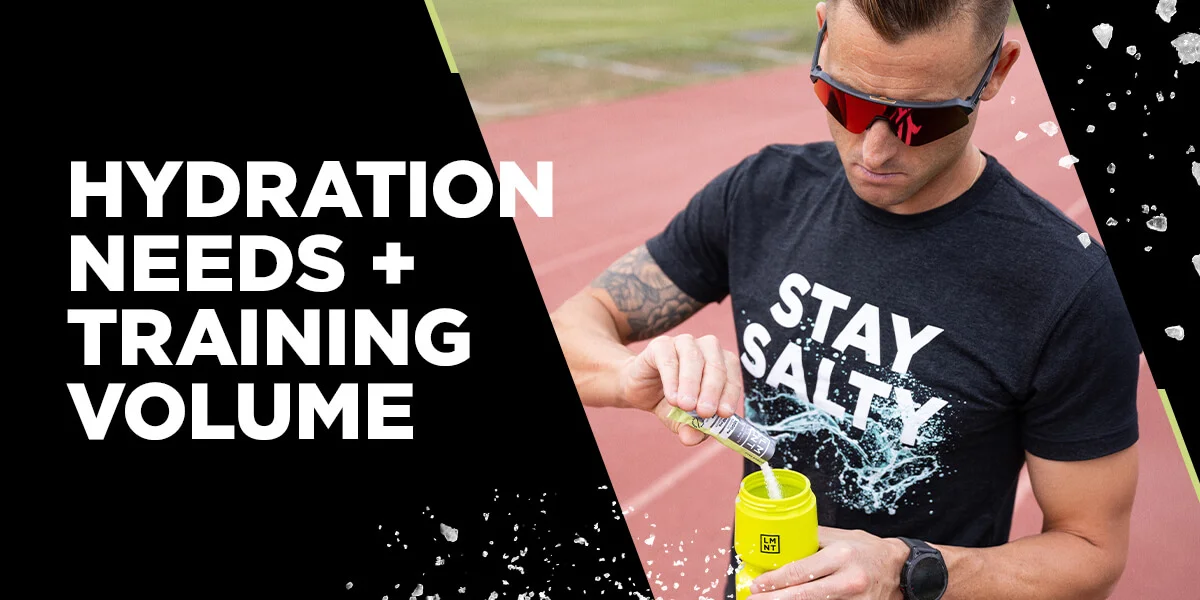
Misjudge, and performance can degrade. American 100-mile record holder and LMNT partner Zach BitterOpens in a new tab has seen this play out in his own training. When he doesn’t nail hydration, runs feel disproportionately hard. “If I'm trying to build back from a moderate case of dehydration, that could take 24 hours,” he says. “A severe case could take 48 hours.” He calls it “stealing from tomorrow.”
So how much do hydration needs change as volume increases? Like most things in physiology, the answer is: it depends.
Hydration-Volume Relationship
A lot of folks don't realize that as fitness and heat acclimation improve, sweating can start earlier and get heavier during exercise — which drives up fluid and sodium needs during and after training.
As cardiovascular fitness increases (also known as your VO2 max), your body gets better at thermoregulation which means you start sweating earlierOpens in a new tab and more efficiently to keep core temperature in check.
Heat adaptation has a similar effectOpens in a new tab. Both are positive adaptations, but they can increase fluid and sodium losses.
Two factors can push sodium losses even higher:
- Intensity: Sweat glandsOpens in a new tab normally pull some sodium back into the body before sweat reaches the skin. As sweat rateOpens in a new tab rises during harder efforts, there is less time for that reabsorption process to occur. One randomized crossover trialOpens in a new tab in 18 male endurance athletes found average sodium loss rates were higher during higher-intensity exercise, increasing from about 706 mg/hour at lower intensity to about 2,196 mg/hour at higher intensity — a difference of roughly 1,490 mg/hour.
- Heat and humidity: Sweat only cools you when it evaporates. In hot, humid conditions, sweat drips off the bodyOpens in a new tab before it can do that job. To compensate, your body produces even more sweat in an attempt to achieve the same cooling effect.
These losses can create problems beyond dehydration itself.
When you’re dehydrated, blood flow is redirected away from the digestive tractOpens in a new tab to support working muscles and cooling. A 2019 randomized crossover studyOpens in a new tab in the Journal of Applied Physiology linked dehydration to exercise-associated gastrointestinal symptoms including abdominal pain and side stitches. When you’re queasy and crampingOpens in a new tab, the last thing you want to do is force down a banana or sports gel.
"If you start getting dehydrated, it's gonna impact how much carbohydrate you can take in," Bitter says. "You could have digestive issues from what otherwise would've worked, which can be really frustrating."
Assessing Your Baseline Hydration Needs
Before you can adjust hydration for higher training volume, you need a rough sense of what you're losing in the first place.
Per a 2017 reviewOpens in a new tab in Sports Medicine, sweat rates can range from roughly 0.5 to 2 liters per hour and sodium concentrations can vary from around 10–70 mmol/L per liter of sweat — which is a pretty huge range. That variabilityOpens in a new tab stems from factors like genetics, heat acclimation, hydration status, and body weight.
So, where should you start? Running coach Bailey LaskoOpens in a new tab suggests most endurance athletes aim for roughly 3–4.5 liters of fluid and around 2,500 mg of sodium per day. Long runs, hard workouts, heat, humidity, and back-to-back training days can all push needs substantially higher.
But every body is different. To get a better sense of your personal baseline, Lasko recommends three simple approaches:
- Track changes in weight. The easiest way to estimate sweat loss is to weigh yourself before and after a run. Subtract your post-run weight from your pre-run weight, then add back any fluid you consumed along the way. The result is a practical estimate of how much sweat you lost during the session.
- Check urine color. Pale yellow is the target, Lasko says. Darker may signal dehydration (though it’s important to consider that color is not always a reliable predictor of hydration status. Urine can be darker due to consuming certain foods, supplements, medications, or recent physical activity).
- Pay attention to signs of high sodium losses. White residue on skin or clothing, eye sting, and a salty taste on skin suggest higher-than-average sodium losses. If you notice these signs, you may need to adjust your intake, Lasko says.
How to Adjust Hydration at Different Training Volume Levels
Once you have a rough sense of your baseline, adjust for your training load. The framework below, developed by Lasko, is designed to give runners a starting point as weekly mileage increases.
Low Volume (20–35 miles/week)
At this stage, hydration is mostly a workout-by-workout concern. For runs under 60 minutes:
- Pre-run: Drink 500ml (~17oz) with 500 mg of sodium — the amount in ½ an LMNT stick pack. Sip an additional 150–250ml of water 30 minutes before heading out.
- Mid-run: Sip (don’t chug!) water throughout
For runs over an hour, add around 250–350 mg sodium before and after the session.
Moderate Volume (35–55 miles/week)
For runners averaging 8+ miles a day, hydration becomes a daily consideration rather than something you think about only before runs. The goal is to arrive at tomorrow's workout recovered rather than spending the next 24 hours digging out of a hydration deficit.
- Pre-run: Drink 500–750ml of water with 500–750mg of sodium. Sip an additional 150–250ml of water 30 minutes before heading out
- Mid-run: Add 350–500 mg of sodium and 500ml–750ml of water per hour
- Post-run: At least 750ml–1L water with another 500 mg of sodium
High Volume (55–75 miles/week)
At this stage, hydration becomes a 24-hour discipline, Lasko says.
- Pre-long run (the night before): Eat a salty, carb-dense meal so you start the next day's workout with full glycogen stores, adequate fluid, and enough sodium on board to support fluid balance. Think: 2 cups of white rice or noodles with soy sauce, non-fibrous veggies and lean chicken.
- Pre-run: Drink 500–750ml of water with 500–750mg of sodium. Sip an additional 150–250ml of water 30 minutes before heading out
- Mid-run: Add 350–500 mg of sodium and 500ml–750ml of water per hour
- Post-run: At least 750ml–1L water with another 500 mg of sodium
Elite/Peak Volume (75+ miles/week)
Consider working with a sports dietitian to build a personalized hydration and electrolyte protocol, Lasko says. Getting a sweat test in a lab is also an option.
That's the route Bitter took.
Through lab testing, he learned that he loses about 614 mg of electrolytes per liter of sweat. That number became the foundation for his mid-run hydration bottles, with adjustments based on heat and humidity. “It’s best to go in there maybe a little saturated with sodiumOpens in a new tab compared to what you normally would do,” he says.
Common Hydrating Mistakes When Increasing Volume
Mistake no. 1: Drinking more water without scaling electrolytes.
Replacing sweat with plain water alone can dilute blood sodium levels, especially during long races or high-volume training blocks. This can result in hyponatremiaOpens in a new tab, a condition where sodium levels in the bloodstream fall below 135mEq/L (normal is 135–145 mEq/LOpens in a new tab), creating an imbalance with total water volume in the body.
“The result is muscular cramping, nausea, headaches, fatigue, and impaired motor skills,” says Lasko. A 2005 observational studyOpens in a new tab of Boston Marathon runners found that 13% of finishers had hyponatremia at the finish line.
Mistake no. 2: Ignoring hydration on rest days.
Going into a run already dehydrated impairs the body’s ability to fully recover from training stress, making it less prepared to handle higher training loads later in the week, Lasko says. To ensure he’s fully hydrated before long runs during high-volume blocks, Bitter includes electrolytes on easy and recovery days.
Mistake no. 3: Relying on thirst alone.
At high training volumes, thirst remains a useful signal, but pairing it with a rough sense of your sweat rate and the day's conditions gives you a more complete picture of your hydration needs. Know your approximate losses, factor in heat and humidity, and let thirst guide you within that context rather than in a vacuum. Keep in mind that, while rare, drinking too much water beyond thirst can cause exercise-associated hyponatremiaOpens in a new tab.
Small hydration missteps become bigger problems as training volume increases. Take stock of your habits now, before your training demands more from them. The earlier you address them, the better prepared you'll be for the training ahead.
FAQs
Q: How much more water should I drink when I increase my mileage?
For the general active population, 2–3L of water per day is a good goal, says running coach Bailey Lasko. Drink more to compensate for any sweat lost during workouts. For those with a higher volume of training, 3–4.5L may be a better goal on training days, according to Lasko. Still, this is highly personal and dependent on individual biology, the intensity and length of runs, and external factors like weather.
Q: Why do I feel more dehydrated as my training increases?
Dehydration is often cumulative. If you're running twice a day or on consecutive days without fully replenishing between sessions, each session starts from a slightly depleted baseline. Over the course of a week, that can add up to a noticeable drop in performance and recovery.
Q: Does sweat rate increase with fitness?
Generally yes. Fitter athletes tend to sweat earlier and more efficiently as their bodies get better at thermoregulation. It's a positive adaptation — but it means fluid and sodium losses increase as fitness improves, which is one reason hydration needs don't stay static as training builds.
Q: How do I calculate my sweat rate for running?
Weigh yourself before and after a run, then use this formula: Fluid Loss = Pre-run weight (kg) – Post-run weight (kg) + Fluid intake (L). Sweat Rate = Fluid Loss (L) / Run time (hours). Repeat the process across different workouts and weather conditions.
Q: What is the best way to stay hydrated during high-volume training weeks?
Treat hydration as a 24-hour practice. Sip water and sodium before, during, and after a run, aiming for 3–4.5 liters of water with ~2500 mg of sodium. Adjust accordingly for longer or hotter sessions.
Q: Should I drink more electrolytes when running more miles?
Running coach Bailey Lasko says it’s a good idea to add more sodium to your water as you scale up the volume. Specifically, 2000 mg of sodium daily is a good goal for low-volume runners. Higher-volume athletes may need closer to ~2500 mg of sodium, and long and intense runs can significantly increase sodium needs.