

Key Takeaways
- For most people, hydration, diet quality, and metabolic health are among the primary drivers of kidney stone formation. Genetic factors that influence urinary calcium, oxalate, and pH also play a role.
- The idea that "salt causes kidney stones" comes from research on people with chronic kidney disease — not healthy populations.
- Healthy kidneys efficiently excrete excess sodium, which is why blanket sodium restriction doesn't make sense for everyone.
If you've ever dealt with kidney stones, you probably got some version of the same advice: Cut back on salt. But for most healthy, well-hydrated people, salt intake is only one factor among many in kidney stone risk. The big drivers are overall diet quality, hydration, and metabolic health.
According to Dominic D’AgostinoOpens in a new tab, PhD, metabolic physiology researcher, kidney stones are strongly linked to excess calcium in the urine — and while sodium can increase calcium excretion, it’s rarely the primary driver on its own. “Sugar is also a pretty potent stimulator of urinary calcium — and probably a bigger contributor for the general population,” says D’Agostino. It’s the combination of high salt and high sugar intake (typically consumed in processed foods) that may be especially problematic, he adds.
So why do so many folks believe that salt causes kidney stones? And where did this advice come from?
The idea that "salt hurts your kidneys" has roots in medical researchOpens in a new tab — but mostly in specific clinical populations, not the general public. Most scientific literature treats sodium almost entirely through a disease-management lens — studying folks with hypertension, cardiovascular risk, or metabolic syndrome and asking whether restricting salt helps them. Healthy people who eat unprocessed diets are not often the research subject of interest.
But back to our history lesson: Decades ago, researchers sawOpens in a new tab that people with chronic kidney disease (CKD) often needed to limit sodium because their kidneys struggled to filter properly. Over time, this medical advice for clinical populations — people with CKD, hypertension, and cardiovascular risk — bled into public health messaging and we stopped asking whether the original research applied to healthy folks. Sound familiarOpens in a new tab?
Current researchOpens in a new tab tells a different story. Kidney stones are linked to diet qualityOpens in a new tab, metabolic healthOpens in a new tab, and hydration, not sodium alone. This just goes to show that a singular mineral in isolation is not the driver of disease risk — the full picture matters.
Let's dig into how kidneys work, how stones form, and what the science says about salt's role.
How the Kidneys Work
Before we can talk about what contributes to kidney stones, we need to understand what kidneys are supposed to doOpens in a new tab.
Kidneys are like water treatment plants — but more sophisticated than anything we humans have engineered.
- They filter waste and metabolic byproducts by clearing out cellular waste, including urea from protein metabolism and creatinine from muscle activity. They're constantly sorting through your blood — keeping essential nutrients and discarding compounds that would otherwise accumulate.
- They maintain acid-base balance and keep your blood at the right pH by excreting excess acid in urine and holding onto bicarbonate (a natural buffer). If blood pH drifts out of range, your enzymes stop working properly — and that impacts everything from energy production to immune function.
- They regulate mineral balance by monitoring sodium, potassium, and magnesium levels, then retaining or eliminating based on what your body needs. For folks with healthy kidneys and metabolic systems, this happens automatically. That's a key point we'll come back to.
- They manage fluid balance and blood pressure by deciding how much water to keep or release. This affects oxygen and nutrient delivery throughout your body.
Healthy kidneys are remarkably good at their job, handling fluctuations in sodium intake just fine — which is why blanket sodium restrictions aren’t right for everyone.
What Are Kidney Stones?
Kidney stones are chunks of minerals that form inside the kidneys. If you've ever passed one, you're probably wincing just reading this.
There are two main types: calcium stones and uric acid stones. Both are influenced by diet, hydration, and metabolic health — but through different mechanisms.
How calcium stones form
Around 80% of kidney stones are calcium stonesOpens in a new tab. They form when calcium binds to oxalate or phosphate in your urine.
When urine becomes too concentrated — whether from dehydration, metabolic issues, or other factors — calcium and other chemical compounds, including oxalateOpens in a new tab (found in foodsOpens in a new tab like spinach, almonds, and chocolate) or phosphateOpens in a new tab (an electrolyte abundant in many foodsOpens in a new tab), can crystallize in the kidneys instead of staying dissolved in urine.
Oxalate, calciumOpens in a new tab, and phosphate are essential compounds your body needs and healthy kidneys handle them without issue. Stones form when other factorsOpens in a new tab including concentrated urine, chronic dehydration, or metabolic dysfunction allow these compounds to crystallize instead of passing through normally. The goal is to address the conditions that cause buildup — not to eliminate health-promoting foods from your diet.
How uric acid stones form
Uric acid stones make up most of the remaining 20%. They form when urine becomes too acidicOpens in a new tab as a result of excess acid production during metabolism — especially from metabolic conditions like insulin resistance. People managing type 2 diabetes, for example, tend to have higher risk of uric acid stones because insulin resistance can impair the kidneys' ability to excrete acid properlyOpens in a new tab.
Notice a pattern emerging? Metabolic health — how well your body manages blood sugar, insulin, inflammation, and energy — keeps showing up as a key factor.
What Drives Kidney Stone Formation?
The research points to a few key drivers. The Standard American DietOpens in a new tab (SAD), metabolic health, hydration habits, and mineral balance all play roles.
The Standard American Diet
The Standard American Diet — characterized by high intake of ultra-processed foods, refined carbohydrates, added sugars, and industrial seed oils — is consistently associated with insulin resistance and metabolic dysfunction in the research literature by delivering a combination of factors:
- High sugar and fructose → insulin resistance → impaired kidney function and more urinary calcium
- High sodium from ultra-processed foods (not from salting whole foods) → potentially more urinary calcium
Staying well hydrated and eating a whole-foods diet rich in potassium tends to lower stone risk overall. One cross-sectional observational studyOpens in a new tab suggests the sodium-to-potassium ratio may matter more than sodium intake alone.
Insulin resistance and metabolic dysfunction
When you eat a diet high in sugar and refined carbohydrates, your cells get bombarded with insulin signals. Think of insulin like someone knocking on your cell's door, asking it to open up and take in blood sugar. At first, your cells respond. But when insulin keeps knocking — snack after snack, meal after meal — your cells eventually get tired of entertaining the insulin guest and start ignoring the signal. They become "resistant" to insulin's effectsOpens in a new tab, even though insulin is still there, still knocking.
Why does this matter for kidney stones? Insulin resistance is linked to several downstream effectsOpens in a new tab:
- It can impair the kidneys' ability to excrete acid, making urine more acidic (a setup for uric acid stones).
- It's associated with increased urinary calcium excretion.
- It's linked to lower citrate levels in urine — and citrate is one of your body's natural defenses against stone formation.
"The high blood sugar contributes to proportionally more urinary calcium excretion, and ultimately kidney stones," explains Dr. D'Agostino.
This is a significant piece of the puzzle that often gets overlooked because so much attention is placed on salt alone.
Fructose consumption
This one deserves attention because it's so pervasive in modern diets.
FructoseOpens in a new tab — abundantly found in added sugars, high-fructose corn syrup, and sweetened beverages — appears to be particularly relevant for kidney health. Unlike glucose, fructose gets metabolized primarily in the liver, where it can contribute to insulin resistance, increase uric acid production, and affect kidney function. Dr. D'Agostino calls the combination of high salt and high sugar in the context of insulin resistance “a synergistic combination recipe” for kidney stones. “High blood sugar contributes to urinary calcium excretion proportionally or more [than salt],” he explains. “It sets you up for getting kidney stones.”
He's particularly concerned about fructose in liquid form. Sugar-sweetened beverages are the single largest sourceOpens in a new tab of fructose-containing sugars in the American diet, accounting for nearly half of all added sugar intake. A 2025 cross-sectional observational studyOpens in a new tab found that drinking more sugar-sweetened beverages correlated with higher kidney stone risk in young and middle-aged adults.
Dehydration
When you're dehydrated, your urine becomes more concentrated. Minerals like calcium and oxalate are more likely to crystallize into stonesOpens in a new tab because there's less liquid to keep them dissolved. “Your hydration status has a lot to do with [kidney stone risk]. The more you drink, the more you're able to excrete excess sodium and regulate that,” says Dr. D’Agostino.
For well-hydrated, metabolically healthy people, kidney stone risk is significantly reduced and "almost a non-issue,” he says.
Low potassium intake
A 2024 cross-sectional analysisOpens in a new tab of NHANES data from 19,405 adults found that higher potassium intakes were associated with lower odds of kidney stones.
Potassium helps prevent stones in two ways:
- It can lower urinary calcium levels.
- It increases urinary citrate levels (citrate binds to calcium in urine, helping prevent stones from forming).
Most Americans don't get enough potassiumOpens in a new tab. If you're thinking about kidney stone prevention, bumping up your potassium intake — through foods like avocados, leafy greens, and potatoes — may be more useful than cutting salt.
So where does salt fit?
Mechanistically, excess sodium can increase urinary calcium excretion. "When you have excess sodium, you have proportionally more calcium in the urine," says Dr. D'Agostino. "And that extra calcium could facilitate the formation of stones."
But this doesn't consistently translate to higher stone risk at the population level. A 2024 cross-sectional analysisOpens in a new tab of over 19,000 adults in the U.S., for example, found no significant link between dietary sodium intake and kidney stone prevalence in the general population.
Why the disconnect? Though chronically high sodium intake can affect blood pressure and mineral balance in certain people, healthy kidneys handle sodium efficiently. When you consume more than you need, your kidneys excrete the excess through urineOpens in a new tab. Salt doesn't just accumulate, making your blood saltier and saltier. Your body has feedback mechanisms for this.
Context matters enormously. "The observational data shows that excess salt is tied to high blood pressure, kidney problems, things like that," says Dr. D'Agostino. "But keep in mind that's in the context of a Standard American Diet of ultra-processed, ultra-sugary, ultra-salty food. We need to appreciate that context."
Sodium-containing foods and sodium itself are two very different things. Sodium is an essential electrolyteOpens in a new tab. It helps regulate fluid balance and supports nerve, and muscle function. But in most ultra-processed foods, sodium arrives bundled with refined carbs, added sugars, and industrial fats — a combination that undermines satiety and drives overconsumption. This is intentional, too: there are food scientists whose work entails creating hyperpalatable foods that are hard to stop eating.
I learned this firsthand. When I was writing Wired to Eat, Doritos Roulette was released in the US — in one handful of chips you were likely to find one extremely spicy one. This really struck me: in one bag, you could experience a wide palate experience, which leads to increased consumption. I was curious whether the objective was flavor, marketing appeal, or pure palatability engineering, so I reached out to Frito-Lay. To my surprise, they responded — and confirmed exactly what I suspected. These are not accidental formulations. These companies operate at an exceptionally high level of sophistication in their understanding of palatability, appetite neuroregulation, and evolutionary biology. That is: They make food that makes your brain want to keep eating them. It isn't the sodium driving that effect — it's the whole package. And most of our medical gatekeepers are largely clueless about these topics.
The point is this: When research fails to distinguish sodium as an ingredient from the ultra-processed, hyperpalatable foods it's engineered into, sodium too often gets blamed for problems caused by the whole package. Cutting sodium in a bag of chips doesn't transform it into a health food — it reinforces the idea that salt is the problem, while distracting from the bigger issue: ultra-processed foods are not good for health.
Who May Want to Watch Their Salt Intake?
We've established that for most healthy people, salt intake is a minor concern for stone risk. But some folks may benefit from being more thoughtful about sodium — and this can shift based on where you are in your health journey:
- People currently managing chronic kidney disease (CKD): When kidneys aren't filtering efficiently, sodium can accumulate more than it should. The National Kidney FoundationOpens in a new tab recommends folks with CKD aim for about 2.3 grams of sodium daily. But kidney function can improve with the right interventions — what's right for you today may look different as your health evolves.
- People experiencing salt sensitivity: Some individuals see significant blood pressure changesOpens in a new tab following moderate salt intakes. Salt sensitivity is more common in people managing CKD, diabetes, or certain genetic factors — but it can improveOpens in a new tab.
- People with a history of calcium stones: If you've had calcium stones beforeOpens in a new tab, your doctor may recommend moderating sodium intake as part of a broader prevention strategy.
If any of these apply to you, work with your doctor to figure out what makes sense for your current situation. There's no one-size-fits-all answer and your needs may change over time.
Who may benefit from more salt
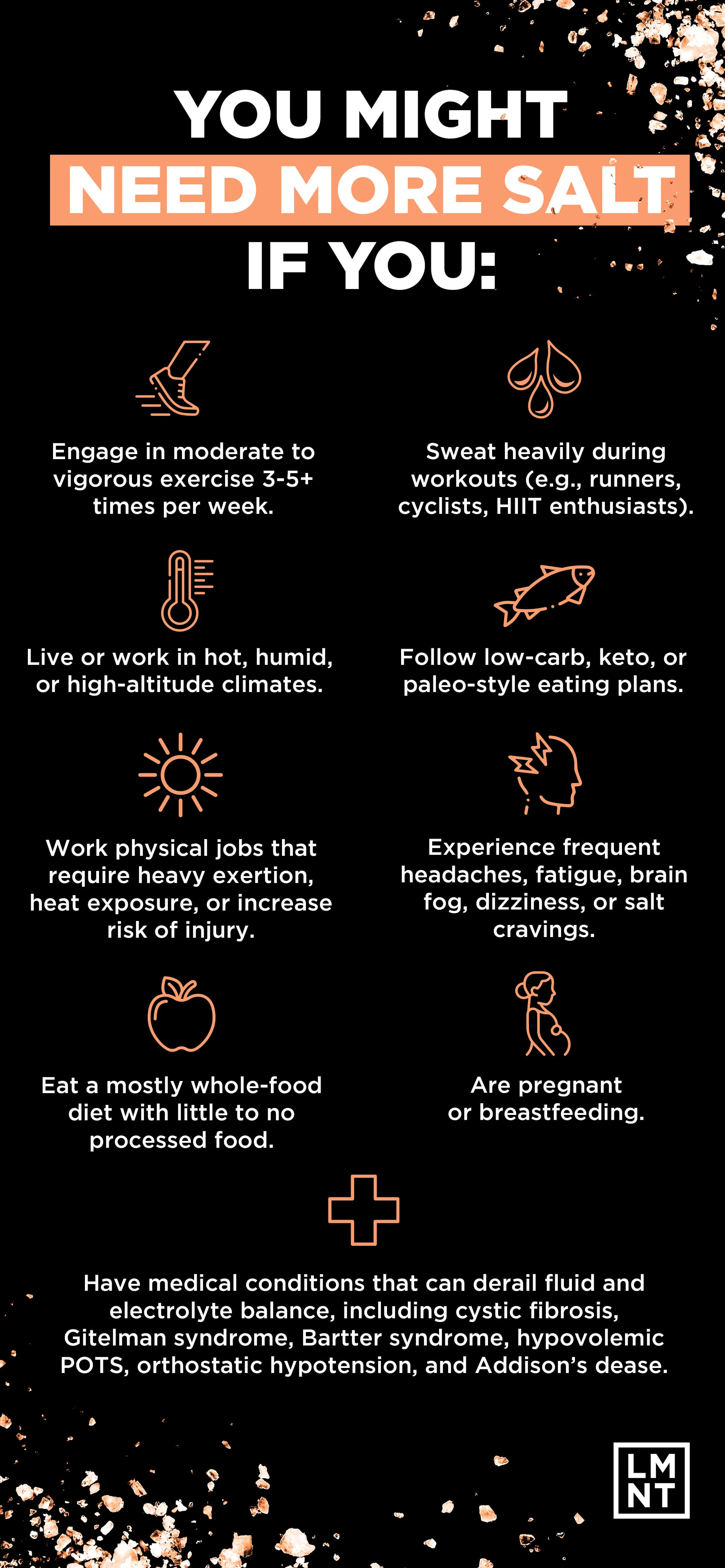
On the flip side, some groups need more sodium — not less.
Whole foods and low-carb dieters: If you avoid processed foods, you're avoiding most of the sodium in the typical American diet. "If you're eating single-ingredient whole food meals, there's hardly any salt," points out Dr. D'Agostino. Low-carb and keto dieters also lose more sodium through urineOpens in a new tab and may need an extra 2–3 grams per day to feel their best.
Heavy sweaters, athletes, and those in physically demanding jobs: Most people lose about 1 gram of sodium per hour of sweaty activityOpens in a new tab. That applies whether you're training for a race, working a construction site, or shoveling snow. Without replacing that sodium, performance and recovery can suffer. Hot, humid climates and high altitudes increase losses further. (Dig in deeper with our guide to sweat sodium lossesOpens in a new tab.)
Pregnant and breastfeeding moms: Pregnancy expands blood volumeOpens in a new tab significantly, increasing the body's demand for sodium and other electrolytes. Lactation also raises fluid and nutrient needs.Opens in a new tab
People with certain medical conditions: Some conditions directly affect how the body handles sodium. Cystic fibrosisOpens in a new tab impairs the body's ability to reabsorb salt from sweat. Postural orthostatic tachycardia syndrome (POTS) and orthostatic hypotensionOpens in a new tab often improve with higher sodium intake. And rare conditions like Addison's diseaseOpens in a new tab, Gitelman syndromeOpens in a new tab, and Bartter syndromeOpens in a new tab impair the body's ability to retain sodium. Anyone managing these conditions should work with a healthcare provider to determine their individual needs.
How to Support Kidney Health and Reduce Stone Risk
A handful of reasonable habits can help prevent kidney stones.
#1: Stay hydrated (the easy win)
Proper hydration is one of the simplest and most effective ways to reduce stone risk. The National Kidney Foundation recommends drinking 2–3 liters of fluids dailyOpens in a new tab for stone prevention — roughly 68–100 ounces, or the equivalent of four to six standard water bottles. That said, your ideal fluid intake depends on body size, activity level, diet, and climate.
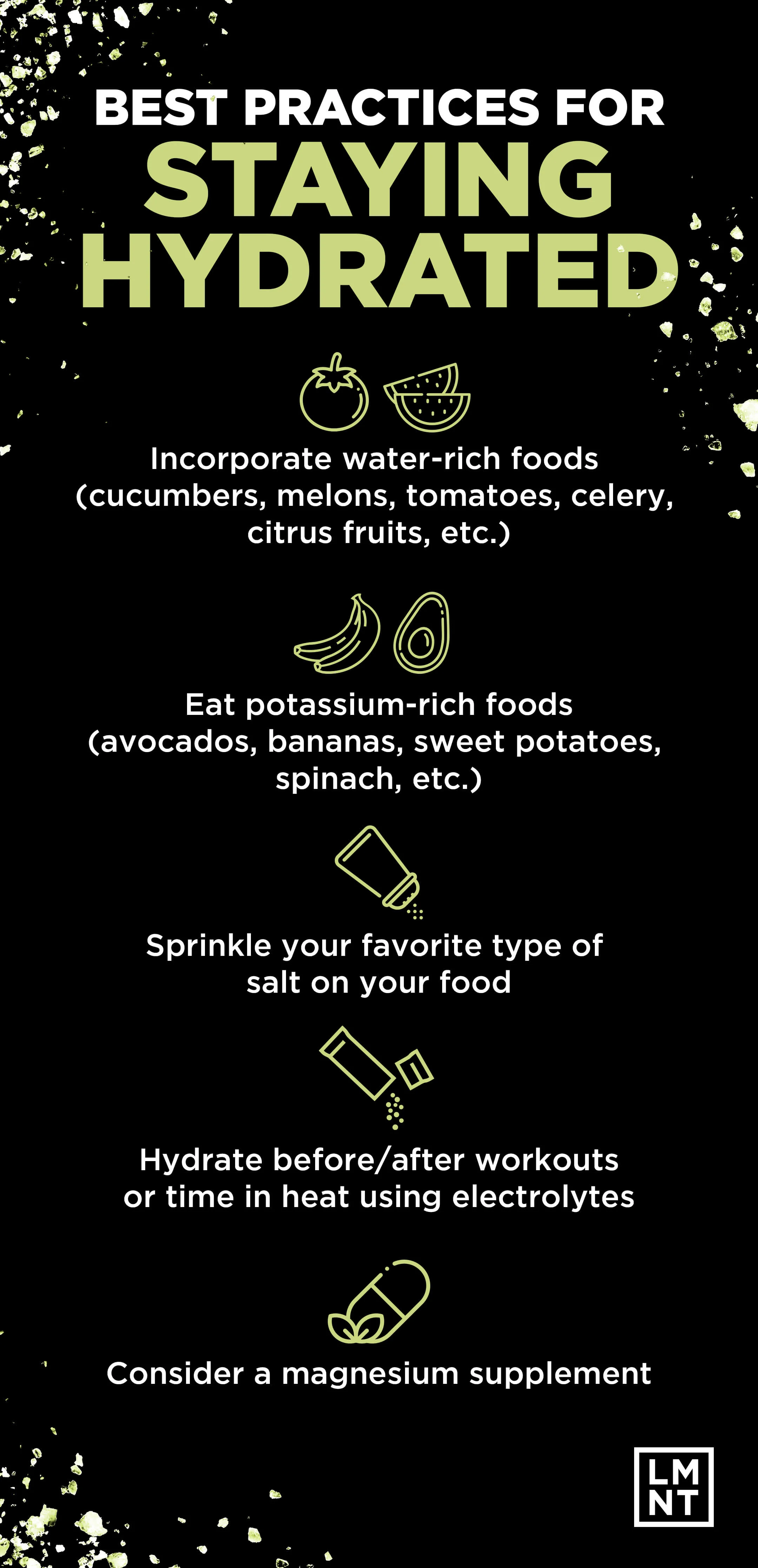
Keep in mind that hydration means consuming fluids and electrolytes. To stay hydrated at the cellular levelOpens in a new tab, you need sodium to help draw water into your cells. Some healthy folks may need more sodium instead of less, especially if they’re very active or eating a whole-foods or low-carb diet. For them, that might look like:
- 4,000–6,000 mg of sodiumOpens in a new tab
- 3,500–5,000 mg of potassiumOpens in a new tab
- 400–600 mg of magnesiumOpens in a new tab
- About 1,000 mg of calciumOpens in a new tab from dietary sources
Many health organizations recommend lower sodium targets, especially for individuals with hypertension or kidney disease, but these targets can shift as those health conditions improve.
Lifestyle interventions — exercise, sleep, stress management — are key to that improvement. Everyone's hydration needs are unique, and as your metabolic health evolves, so does what works for you. You feel the difference when you get it right.
#2: Prioritize whole foods when you can
Ultra-processed foods — sugary sodas, packaged snacks, fast food, sweets — contribute to many of the factorsOpens in a new tab we've discussed: insulin resistance, high fructose intake, and metabolic patterns that can affect kidney function.
When we say "processed foods," we're not talking about minimally processed items like canned beans or frozen vegetables. We're talking about foods manufactured with added sugars, refined carbs, industrial fats, and additivesOpens in a new tab.
Reducing these foods cuts a major source of sugar and fructose. But it also cuts a significant source of sodium — a bigger one than most people realize. More than 70% of the sodium Americans consume comes from packaged and processed foodsOpens in a new tab.
If you shift toward whole foods, your sodium intake doesn't just dip — it drops dramaticallyOpens in a new tab. Whole foods like vegetables, fruits, and unprocessed meats contain very little sodium on their own. A sprinkle of salt at the dinner table won't come close to replacing what you were getting from packaged and processed foods. You may need to be more intentional about your salt intake.
#3: Get enough potassium and citrate
Since potassium and citrate both support stone prevention:
- Eat potassium-rich foodsOpens in a new tab: avocados, leafy greens, potatoes, bananas, beans
- Get citrate from citrus fruits: lemons, limes, oranges, grapefruit
- Consider supplements if helpful: potassium citrate addresses both needs at once
#4: Support metabolic health
Exercise, sleep, and stress management all help maintain insulin sensitivity — which in turn supports kidney health.
All types of exercise help with insulin sensitivity, especially higher-intensityOpens in a new tab work like sprinting or interval training. Exercise helps ensure your cells respond when insulin signals arrive.
Good sleepOpens in a new tab and stress managementOpens in a new tab matter too. You don't need to optimize every variable at once — just do what's reasonable within your lifestyle. Small improvements compound over time.
#5: Other considerations
- Be mindful of high-dose vitamin C supplements. Megadosing vitamin COpens in a new tab — generally 1 gram or more per day — can increase oxalate excretion in urine, which may raise calcium oxalate stone risk over timeOpens in a new tab. For context, many popular vitamin C supplements contain 1,000 mg (1 gram), and some "immune support" products recommend even higher doses. Getting vitamin C from whole foods like citrus, bell peppers, and broccoli is unlikely to cause issues.
- Get adequate calcium from food. Counterintuitively, dietary calcium (dairy products, leafy greens, canned fish with bones) can help reduce stone riskOpens in a new tab by binding to oxalate in the gut before it reaches the kidneys. Aim for about 1 gram daily from food sources — calcium supplements, by contrast, may actually increase stone risk in some peopleOpens in a new tab.
Final Thoughts
So does salt cause kidney stones? For most healthy people, salt appears to be a minor factor — not a primary driver.
Context matters. Someone who's dehydrated and eating a Standard American Diet may have higher stone risk when sodium intake is also high — because these factors compound. Someone who's well-hydrated and eating whole foods? Salt intake is unlikely to be the determining factor.
The evidence suggests we've been villainizing salt for decades — generalizing research from clinical populations to healthy folks who don't have the same underlying issues.
If you're thinking about kidney stone prevention, focus on the foundations: Stay hydrated. Eat whole foods when you can. Get enough potassium. Support your metabolic health. These are the easy wins that make the biggest difference — and they don't require fearing the salt shaker.