
Why your caffeine tolerance is different from everyone else’s

Written by Robb Wolf (opens in a new tab)
Medically reviewed by Ecler Ercole Jaqua, MD, MBA, DABOM (opens in a new tab)
Key takeaways:
- Caffeine tolerance varies widely. The difference comes down to genetics, stress load, hormones, sleep, and nervous system reactivity.
- CYP1A2 is the enzyme driving most of that variation. This liver enzyme metabolizes ~95% of the caffeine you consume. Genetic variants split people roughly into fast and slow metabolizers, which is why caffeine's half-life can range from one person to the next.
- Environment and habits can shift your metabolism. Age tends to slow CYP1A2 down. Estrogen (including from oral contraceptives and HRT) competes with caffeine for the same enzyme, extending its half-life. Smoking speeds metabolism up by as much as 50%.
- Your nervous system shapes the experience even more than your metabolism. Stress, anxiety, and sleep deprivation all prime your system for overstimulation — which is why the same dose that feels great on vacation may feel terrible on a stressful Tuesday.
- The best way to find your personal Goldilocks zone is to listen to your body. Run a simple two-phase experiment: Establish a baseline with a consistent dose and timing, then shift the timing an hour later each day until sleep starts to suffer. You are not average, and the body's response is more useful than any universal guideline.
LMNT co-founder Luis Villaseñor can drink a quad espresso at 8 p.m. and fall asleep soon after. Once I drank a cup of green tea before a mid-afternoon workout, stayed wired for hours afterward, and struggled to sleep that night.
Unfair? Maybe. But it illustrates an important point: Biologically, caffeine tolerance varies widely. Genetics influence how quickly your body metabolizes caffeine. Stress, sleep quality, and hormones also change how the same dose feels from one person to the next.
Now that you understand how caffeine works (we talked about that hereOpens in a new tab), let’s talk about tolerance and variability.
How Genetics Affect Caffeine Metabolism
Meet CYP1A2Opens in a new tab: a liver enzyme that breaks down roughly 95% of the caffeineOpens in a new tab we consume — and one big reason people experience caffeine differently.
To understand why CYP1A2 matters, it helps to follow caffeine’s path through the body. Let’s start from the beginning — you drink a cup of coffee (or a LMNT Lemonade Iced TeaOpens in a new tab). Here’s what happens next:
- Caffeine gets absorbed into circulation. It moves through your bloodstream and travels where blood goes — including your brain and liver.
- Some caffeine crosses the blood-brain barrier and binds to adenosine receptorsOpens in a new tab. Normally, adenosine promotes sleepiness. But caffeine blocks those receptors, delaying the sleepy signalOpens in a new tab and shifting brain chemistry toward alertness. The more caffeine in your bloodstreamOpens in a new tab, the stronger the effect (and higher likelihood you’ll experience a crash).
- Meanwhile, blood carries caffeine to the liver. This is where CYP1A2 goes to work, metabolizing caffeine into several compounds. About 80% is converted into paraxanthineOpens in a new tab, a metabolite with its own stimulating properties. Smaller amounts become theobromine and theophylline before eventually being cleared from the body in urine.
- Blood concentrations gradually fall. As CYP1A2 metabolizes caffeine, blood concentration levels gradually fall. Fewer adenosine receptors stay blocked, and the stimulating effects fade.
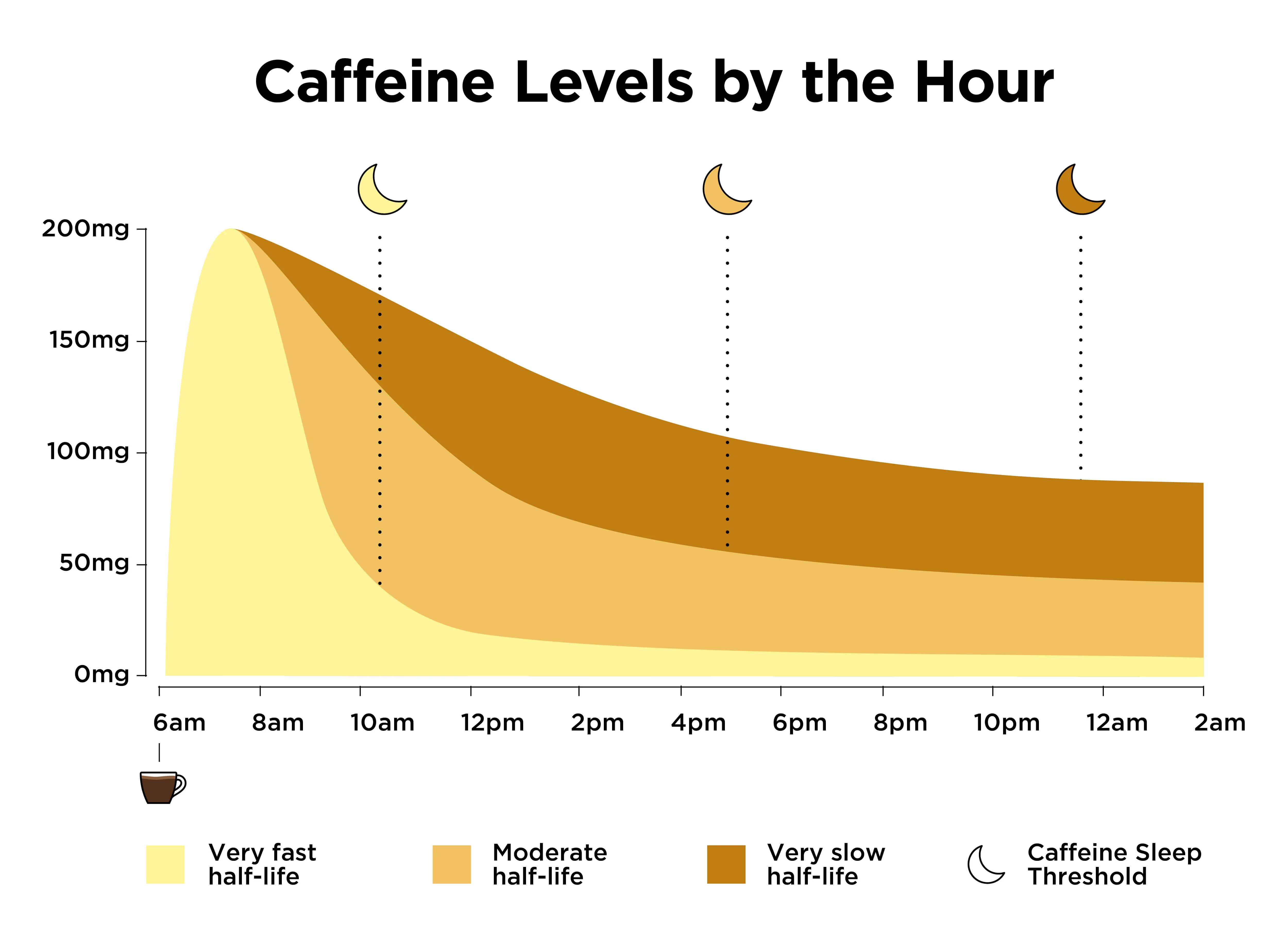
On average, caffeine’s half-life — the time it takes for blood levels to drop by 50% — is 4–5 hoursOpens in a new tab. But averages hide a lot of individual variability and you are not average. Depending in part on genetic variations in CYP1A2 activityOpens in a new tab, caffeine’s half-life can range from 1.5–9.5 hoursOpens in a new tab for adults — or even up to 12 hours for some specific populations (those who are pregnant, have liver conditions, or experience medication interactions).
It’s worth noting this range changes depending on the expert you ask. Some claim 1.5–9.5 hoursOpens in a new tab, others claim 2–12Opens in a new tab. That’s just another reason to take guidelines with a grain of salt (pun intended), and pay attention to how your body responds.
Fast vs slow metabolizers
Think of ingesting caffeine like filling a bathtub and your CYP1A2 enzyme as the drain.
- If you carry a “fast” CYP1A2 genetic variant, the drain is wide open and caffeine flows out efficiently. You feel the effects, but they taper sooner and you’re back to baseline faster.
- With a “slow” variant, the drain is partially clogged. Caffeine leaves your system more slowly, so the same dose produces longer-lasting effects.
Fast metabolizers may find recommendations like cutting off caffeine by 12 p.m. unnecessarily conservative. An after-dinner espresso might not affect their sleep at all.
Slow metabolizers, on the other hand, may feel caffeine’s effects longer and more intensely, with sleep disruption even from early-day intake. And research suggests doses even as low as 50 mgOpens in a new tab can increase alertness — not really what you need before bed.
How do you know if you’re a fast metabolizer, a slow metabolizer, or somewhere in the middle?
Research suggests caffeine metabolism varies by genetic ancestry. EuropeanOpens in a new tab populations may have higher CYP1A2 activity than South AsianOpens in a new tab and East AsianOpens in a new tab populations. Some Middle Eastern groupsOpens in a new tab also show low rates of slow metabolizers. In other words: Where your ancestors come from may influence how quickly you clear caffeine. But genetics aren't the whole story. Environment and habits can shift how your body handles caffeine.
You can determine your caffeine metabolism rate with CYP1A2 genetic testing. Another, easier way to test it: Run an at-home, two-phase experiment.
Step 1: Establish your baseline. For a few days, drink a single serving of caffeine at the same time each morning, and keep your sleep and wake times consistent. Notice how you feel — energy, focus, sleep quality. A few important caveats:
- If you have a hard time sleeping when starting this experiment, you may want to consider moving your intake time earlier or lowering your dose — think: an 8oz versus 12oz cup of home-brewed coffee or switching to tea.
- The bean, brewing technique, and brand can alter the amount of caffeine in a single serving. Order a 12oz Americano at three different cafés and you could walk out with three wildly different caffeine doses. For this experiment, stick with the same source everyday.
Step two: Shift the timing. Starting the following week, move your caffeine about an hour later each day. Keep the dose and your sleep schedule the same. Track how it affects how you feel by afternoon and your sleep. When you notice sleep quality start to decline — difficulty falling or staying asleep — you’ve exceeded your personal caffeine cut-off time. Dial it back.
What Else Affects How You Metabolize Caffeine
You know the old saying, genetics loads the gun, environment pulls the trigger? Environmental and physiological factors can increase or decrease CYP1A2 activity, changing how long caffeine sticks around in your system:
- Age: The research here is mixedOpens in a new tab but some evidence suggests caffeine-metabolizing enzymes become less efficientOpens in a new tab as we get older.
- Hormones: Estrogen and caffeine compete for metabolism by CYP1A2 enzymes, so people with higher estrogen exposure — including womenOpens in a new tab and those using estrogen replacement therapyOpens in a new tab or oral contraceptivesOpens in a new tab — often experience a longer caffeine half-life.
- Smoking: Compounds in cigarette smoke increase CYP1A2 activity, which can reduce its half-life by up to 50%Opens in a new tab.
How much caffeine you consume (dose) — and how often (timing and total daily intake) — can also change how stimulating it feels. We’ll talk about that in the next article, “Timing, dosing, and cycling: Personalizing your caffeine strategyOpens in a new tab”.
Before we get to that, there’s one more contributing factor to consider when assessing your caffeine tolerance, and that’s how reactive your nervous system is.
Your Nervous System Shapes How Caffeine Feels
People with highly sensitive personalitiesOpens in a new tab — roughly 30% of peopleOpens in a new tab in the populations studied — appear to be more sensitiveOpens in a new tab to caffeine. More research is needed to determine what share of the global population is highly sensitive to caffeine.
One studyOpens in a new tab found that many people with panic disorder and some with generalized anxiety disorder experience panic attacks at high caffeine doses of 480 mg — about the amount in one Venti (20-ounce) Starbucks blonde roast — while a single dose of 150 mg is generally well toleratedOpens in a new tab.
Caffeine raises levels of norepinephrine, epinephrineOpens in a new tab, andOpens in a new tab cortisolOpens in a new tab — hormones that heighten alertnessOpens in a new tab but also raise blood pressure, trigger heart palpitations, and make you feel jittery at high enough levels. If those hormones are already elevated from stress, consuming caffeine could push your system further into overdrive.
When you’re already stressed out and sleep-deprived, that’s probably when you feel like you need caffeine the most, but that’s likely not the case — in fact, in many cases, the opposite may be true. For example, you may notice the opposite effect on vacation. You’re well rested and relaxed and think, “Man, I had four coffees today and felt great.” No jitters, no feeling strung out.
What’s interesting is that caffeine tolerance — and even its benefits — often mirror your overall stress load. If you’re already operating at about 99 percent capacity, adding more stimulation probably isn’t helping.
Bottom Line: Caffeine Tolerance is Personal
The wide range of responses people have to caffeine doesn’t mean caffeine is unreliable. It means human biology varies. Genetics, stress load, sleep, hormones, and habits all shape how caffeine behaves in your system.
The practical takeaway is simple: Pay attention to your own response. Reflect on how caffeine affects you in different situations and experiment. A little self-observation will tell you far more than any one-size-fits-all caffeine guideline ever could.
If you’re still with me — and want even more — let’s dive into “Timing, dosing, and cycling: Personalizing your caffeine strategyOpens in a new tab”.
This was the second article in our six-part caffeine education series. Want to read the other articles? Check them out below:
- How caffeine works: The science behind perceived energyOpens in a new tab
- Timing, dosing, and cycling: Personalizing your caffeine strategyOpens in a new tab
- How caffeine influences mental performanceOpens in a new tab
- How caffeine influences physical performanceOpens in a new tab
- Is all caffeine the same? Why the source mattersOpens in a new tab