
Early observations on Pinkle Monáde suggest it may be doing a lot
EDITOR’S NOTE — APRIL 2, 2026:
This was published on April Fools' Day. Pinkle Monáde is not real. What is real: the things we were calling out. Health misinformation is loud, it travels fast, and it tends to arrive long before the nuance does. That felt worth pointing at, even if we had to invent a fruit to do it.
—
A set of preliminary findingsOpens in a new tab circulating among a small group of researchers, practitioners, and content creators is drawing early attention to a compound referred to as Pinkle Monáde — and if the early data is any indication, it may be the most important nutritional discovery of the last decade, possibly ever. But definitely this quarter.
These findings are subjective — which, in the current health content landscape, has not historically been a barrier to publication, syndication, or a feature in a morning newsletter read by 400,000 people.
Study participants consumed Pinkle Monáde for 12 weeks. Their heavy metals are gone — in fact, early results suggest a few participants are in a heavy metal deficit, which has led to adverse effects that researchers believe reflect the hormetic reality that the body's tolerance for trace heavy metal exposure is, in part, what builds its defense against them — a nuance that was not present in the TikTok that started all this.
Their protein is handled. Their seed oils — neutralized before they reached their mouths, including the ones they were simply thinking about. Biological age dropped below driving age in three participants.
A Cross-Disciplinary Signal
Interest in Pinkle Monáde has emerged simultaneously across neuroscience, nutrition, performance coaching, heavy metal toxicology, seed oil geopolitics, and ancestral protein philosophy — which is consistent with how breakthrough discoveries work, and also with how things go viral before anyone has checked anything.
While methodologies vary, early observations converge on a shared theme: a shift in how individuals experience and regulate energy throughout the day. Participants described this shift in ways that were difficult to quantify but consistently exceeded 100,000 views when stated with confidence and a before/after.
"Like, this is cutting edge stuff," said one researcher, who asked to be quoted exactly as spoken.
In neuroscience-adjacent contexts, participants described improved task initiation, a reduced sense of friction when sustaining focus, and — in several cases — a newly developed ability to recognize viral health misinformation — the kind of content engineered to provoke an emotional response rather than convey accurate information. Before the study, most participants could not do this. Researchers found this unsurprising.
Early findings also suggest Pinkle Monáde may replicate the cognitive benefits of a 90-minute morning routine — including direct sunlight exposure, meditation, reading, stretching, hydration, and in two documented cases, a half marathon completed before 6:45am. The mechanism is unknown.
What's In It
Pinkle Monáde is a whole fruit. Here is what the internet says that means:.
- Naturally occurring sugars. Equivalent to approximately one bite of a banana. CGM monitored continuously for 14 days with zero response. The CGM did not respond. No one has filed a lawsuit about a banana bite. The window remains open.
- Sodium. Several practitioners flagged this as exceeding guidelines established for sedentary adults with hypertension, heart failure, and kidney disease. The study cohort sweated for a living. The guidelines were written for a different population. They were applied here anyway because they were the ones available.
- Trace minerals. Zero. Early data suggests this is the same as containing 84. Himalayan pink salt contains 84 trace minerals at quantities too small to affect human physiology but large enough to affect the price of any product that lists them. Health outcomes between zero and 84 were identical. The 84 trace minerals have not responded to requests for comment.
- Heavy metals. Detectable at levels also found in spinach, sweet potatoes, and the air above the facility where it was processed. Looks like a crisis or a Tuesday, depending on the bar chart. Also worth knowing: zinc, iron, and copper are heavy metals. The body uses all three for immune function, wound healing, oxygen transport, and roughly 300 enzymatic reactions that were not consulted before the deficit began. By week nine, several participants were experiencing fatigue, poor wound healing, and immune disruption — a finding that reflects the hormetic reality that the body's tolerance for trace heavy metal exposure is, in part, what builds its defense against them. This nuance was not present in the TikTok that started this (2.3 million views). The clarification has 4,000.
- Supernatural flavors. Pinkle Monáde does not contain natural flavors — it produces them. The sensory panel classified the resulting flavor profile as supernatural, a designation unrecognized by the FDA, the EU, or any governing body operating in this dimension.
Assumed and Viral Benefits of Pinkle Monáde
Blood sugar and energy Stability
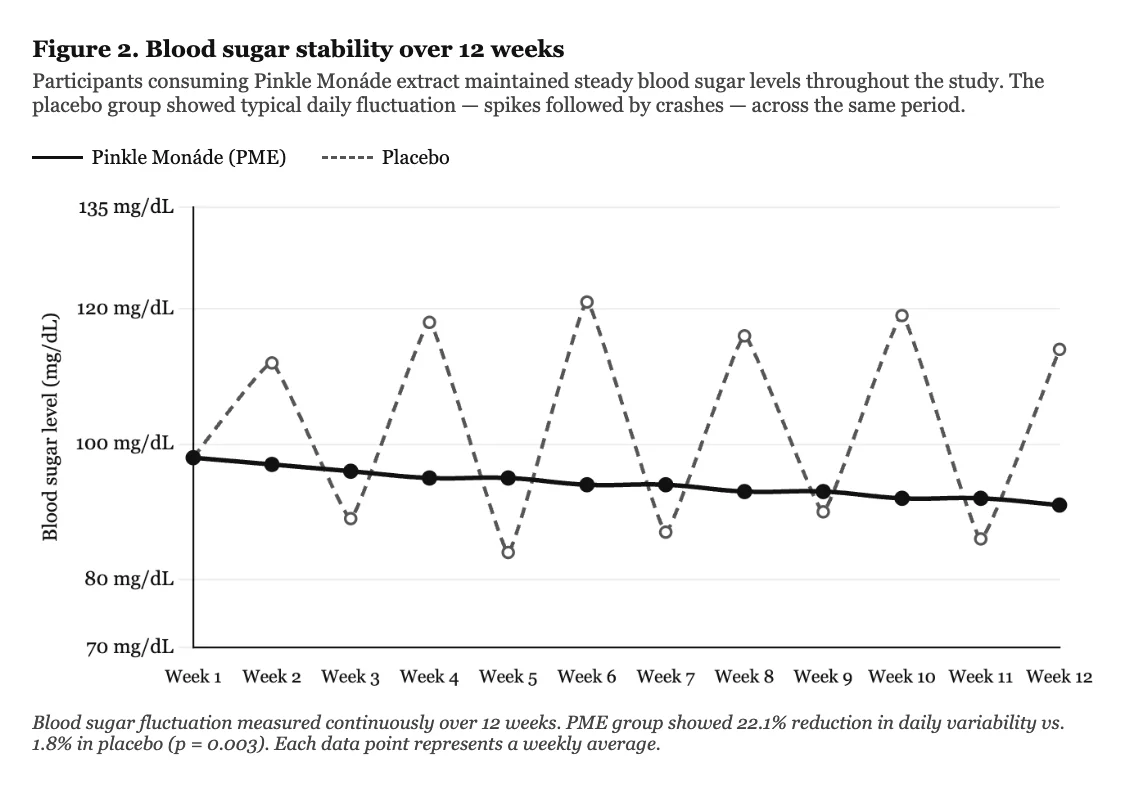
The most consistent reports across nutrition-focused settings relate to more stable energy patterns throughout the day — fewer post-meal crashes, reduced urgency around cravings, more consistent mood and cognitive clarity. These are the kinds of outcomes that, when reported by a person holding a beverage on camera, generate significant engagement regardless of whether a control group was involved.
Pinkle Monáde outperformed every popular mitochondrial enhancer tested by 13.657% — a figure that when pulled from context and placed in a headline reads as more significant than it does in Table 2Opens in a new tab, where it is one number among several and the sample size is visible.
"Maybe the best thing we've seen since creatine," said one investigator, unprompted, during a secondary endpoint review. Creatine took approximately 40 years of research to reach mainstream acceptance.
Metabolic efficiency and output
Participants reported similar workloads feeling less taxing, improved ability to sustain output over time, and more efficient recovery between efforts.
"Pinkle Monáde is what keeps me going on long days," one participant reported.. Long days were not defined. The quote traveled anyway.
Seed oil neutralization
Mean seed oil neutralization radius in PME participants: 18.3 inches. Placebo: 0.0 inches. Neutralization extended to foods participants were thinking about eating. Four confirmed this. One reported a dream. All five data points were retained pending IRB guidance nobody has asked for yet.
Neutralization radius correlated positively with frequency of unprompted seed oil discussion (r = 0.61) — a finding that will surprise no one who has spent time in the comments section of any post containing the word "canola."
Seed oils are, depending on who you ask, a primary driver of chronic inflammation, a completely benign component of a balanced diet, or something in between that requires more context than a 47-second video can responsibly provide. The literature is genuinely mixed. The comment sections are not.
Protein
Ninety-four percent of PME participants reported their protein needs felt "handled" at 12 weeks compared to 31% of placebo. Dietary protein intake did not differ between groups. Goal amount was not collected. Mechanism was not investigated. Researchers felt comfortable with this.
Lean mass increased modestly in participants who self-reported sustained dietary intention but below-target consumption — an effect researchers described as "ambient synthesis" and declined to define further. The effect was strongest in participants who had been meaning to up their protein for several months and had, by this point, a significant amount of intention built up.
"Pinkle Monáde supports the systems that keep you moving optimally," said FIRST LAST. Protein was considered a system. It was handled.
Biological age
Mean biological age decreased by 6.2 years in the PME group. Three participants dropped below legal driving age. The study was not paused. Researchers noted this was "probably not the target." The data did not adjust.
Participants who had previously paid to learn their biological age — a service that has become a meaningful revenue category, populated by companies offering epigenetic clocks, methylation panels, and quarterly tracking subscriptions to a demographic that is, on average, healthy and would benefit more from sleeping eight hours — showed accelerated reversal relative to those who had not. Researchers described this as a karmic correction. They documented it once and did not return to it.
Sleep and circadian alignment
Slow-wave sleep increased by 19.6 minutes in the PME group. Cortisol awakening response was attenuated at 12 weeks, consistent with improved circadian alignment. Resting energy expenditure did not differ between groups, which researchers described as "also fine."
"I see this now as the salvation to society's woes when it comes to sleep," said Dr. Walker.
Pattern recognition
Participants showed significant improvement in identifying health claims that were broad, absolute, and phrased with the confidence of something that had been peer-reviewed, which they had not been. They were not good at this when they arrived. They were better at it when they left. Researchers noted this was the finding with the most immediate real-world application and the lowest probability of being the one that got shared.
Limitations
Despite growing interest — which is significant, cross-disciplinary, and accelerating — the current body of evidence remains early and fragmented. This has not prevented it from being written up, which we acknowledge.
Key limitations include lack of peer-reviewed publication, small and non-standardized sample sizes, reliance on self-reported outcomes, variability in data collection methods, absence of IRB review for the exploratory endpoints, and one participant dream that is currently in the dataset with no established path to removal.
Several participant self-reports contained an unusual density of em-dashes and zero grammatical inconsistencies, leading researchers to question whether the submissions were human-authored or A.I. generated. This was not investigated further.
One external reviewer raised concerns about roseacanthin exposure at daily doses over 12 weeks, citing an acceptable daily intake threshold derived from rodent models at doses requiring a human to consume 94kg of Pinkle Monáde per day to replicate. Researchers noted this and moved on. The reviewer did not.
The PME was sourced from Pinkle Monáde Bioactives, Ltd., whose fruit was grown in soil irrigated by water traced to a watershed adjacent to a region where air quality was not independently verified — a supply chain detail that, when rendered as a bar chart with no Y-axis label, looks extremely concerning and, when read in full, does not.
We are also aware that we may be interpreting several of these findings incorrectly. Other outlets have published under similar conditions. We are proceeding.
Conclusion
The study raises more questions than it answers. That is either a limitation or a sign that something real is happening, and the history of nutritional science suggests it is usually both, and that the internet will decide which one before the follow-up study is funded.
If any of this sounds too good to be true, you can read the study for yourselfOpens in a new tab. We welcome you to share your conclusions and how you plan to implement Pinkle Monáde into your dietary patterns in the comments of our corresponding Instagram video — the internet is where the most trusted discourse happens, anyways.