
How caffeine influences mental performance

Written by Robb Wolf (opens in a new tab)
Medically reviewed by Ecler Ercole Jaqua, MD, MBA, DABOM (opens in a new tab)
Key takeaways
- Caffeine's mental benefits kick in at surprisingly low doses. Reaction time improves with as little as 12.5 mg. Attention, alertness, and executive function show benefits at 32–60 mg. Finding your "target zone" varies by person.
- Caffeine narrows your focus — so match it to the task. It shines for convergent thinking: deep work, studying, data analysis, anything requiring sustained attention on a defined outcome. It's less useful for divergent, generative thinking like brainstorming.
- Smaller, spaced doses outperform heroic ones. 50 mg every couple of hours through the morning and early afternoon — timed around your most cognitively demanding work — delivers a smoother ride, avoids the crash, and protects your sleep.
- Mood is shaped by caffeine too — but the ceiling is personal. Caffeine boosts dopamine and norepinephrine activity, which lifts mood and motivation. But stress load, anxiety disorders, and the source (a cold brew hits differently than L-theanine-paired tea) all shift where your personal sweet spot sits.
- Regular intake may offer real long-term brain protection. Large observational studies link coffee and tea consumption to a 9–22% lower risk of dementia and up to 40% lower Parkinson's risk. Decaf doesn't seem to deliver the same effect, suggesting caffeine itself is doing much of the neuroprotective work — with polyphenols and L-theanine adding support.
I spent half a decade talking to folks in the special operations communityOpens in a new tab about how sleep, stimulants, and food shape resilience and recovery — because when you’re under pressure and need to make fast, accurate decisions, every tool matters.
Stimulants were central to those conversations. These operators were running on energy drinks and coffee, and it was degrading the very edge they were trying to protect.
Caffeine at low-to-moderate doses — roughly 50 mg, the amount in about a half a cup of standard brewed coffee or LMNT Lemonade Iced TeaOpens in a new tab — can boost alertness, reaction time, accuracy, and even moodOpens in a new tab. But overshoot and you risk losing out on these cognitive benefits — and then some.
When used properly, caffeine really works — that’s why it’s the world's most widely used psychoactive substanceOpens in a new tab. It acts on the central nervous system and alters brain function, changing how we think and feel. Not by generating energy or intelligenceOpens in a new tab, but by muting the brain’s fatigue signals.
The long-game is promising too: Over time, coffee and tea intake — thanks to caffeine and other bioactive compounds — is linked to lower risk of Parkinson'sOpens in a new tab, Alzheimer'sOpens in a new tab, and cognitive declineOpens in a new tab.
Let’s explore the short- and long-term cognitive effects, so you can make the most of both.
How Caffeine Affects Mental Performance
Caffeine’s mental benefits stem from its ability to block fatigue signals and keep alertness-enhancing, mood-boosting neurotransmitters online.
Increases alertness, attention, executive function, and more
A primary reason folks tend to love caffeine is for its mental acuity and focus-sharpening benefits. What many don't think about is the series of biological events behind the scenes to get you those results.
First, we have to consider adenosine — a brain chemical that builds up the longer you're awake. As it accumulates and binds to its receptors (“docking stations” on brain cells), it sends signals that slow neural activity — making you tired. Once you sleep, levels reset and you feel more alert.
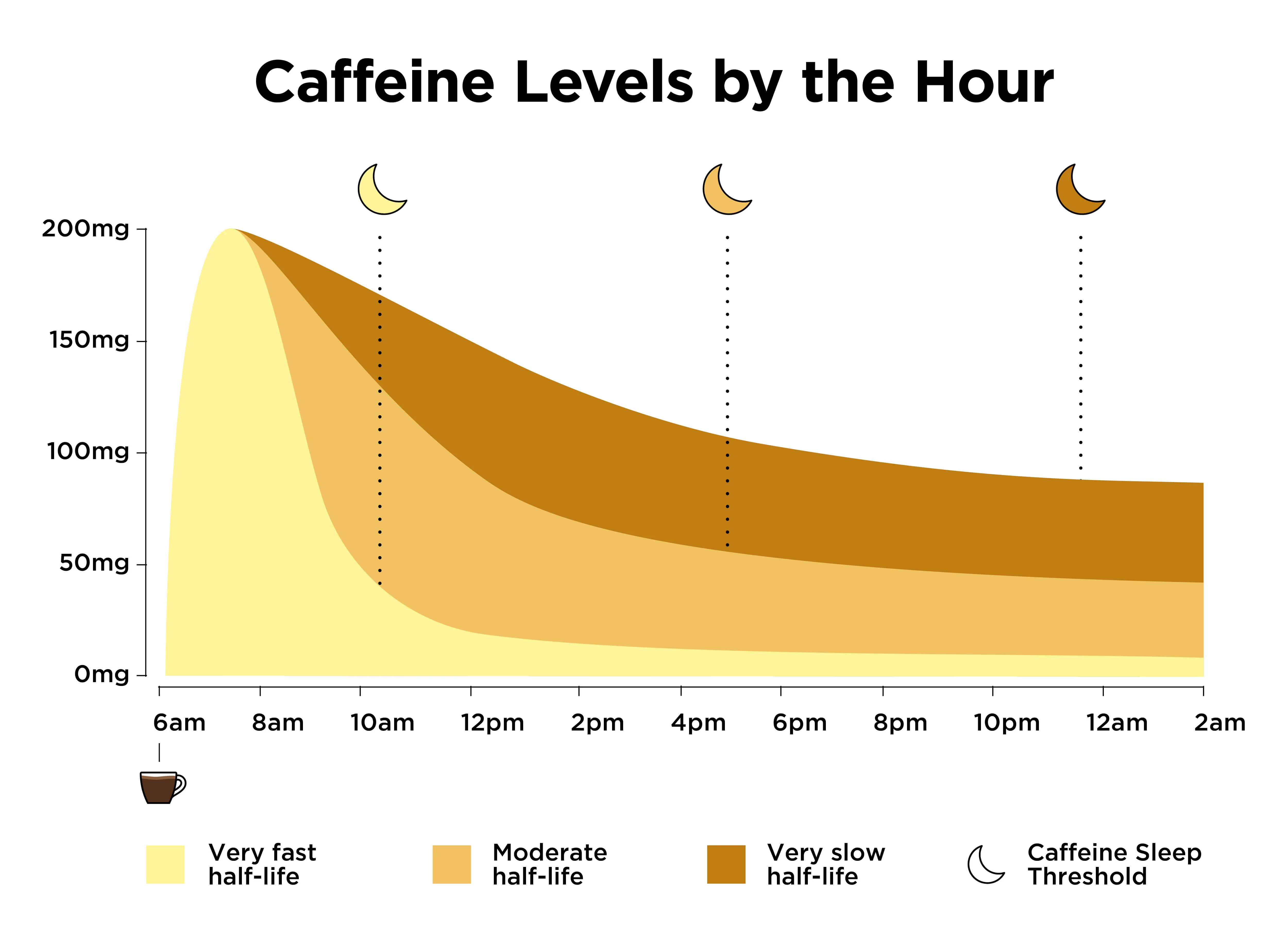
Say you woke up this morning at 6 a.m. At that point, adenosine is at its lowest and starting to rise. You get some sunlight. Get some movement in. Check work emails. And before diving into some focused work, you reach for caffeine. Here’s where things get interesting:
- Once consumed, caffeine gets absorbed in your gut (mostly the small intestineOpens in a new tab), enters the bloodstream, and crosses the blood-brain barrierOpens in a new tab — where adenosine has been accumulating and binding to receptors since you woke up.
- Caffeine and adenosine molecules are shaped similarlyOpens in a new tab, so as caffeine enters the brain, it crowds adenosine out, and binds to some of those receptors.
- With adenosine locked out of its receptors, its fatigue signals can't get through. Neurons keep firingOpens in a new tab, increasing the concentration and activity of alertness- and mood-boosting neurotransmitters like dopamine, norepinephrine, and acetylcholine.
- The result? You feel more awake and upbeat. These same neurotransmitters also supportOpens in a new tab memory, learning, decision-making, concentration, and motivation — which helps explain caffeine’s link toOpens in a new tab faster reaction time, sustained attention, and stronger executive functionOpens in a new tab.
“Caffeine is very good at improving your focused attention and reaction time so you can process information and respond quickly,” says neuroscience professor, sleep expert, and LMNT partner Matthew Walker, PhDOpens in a new tab. “Where caffeine really shines cognitively is what we call convergent thinkingOpens in a new tab — narrowing your focus onto a specific, targeted outcome. Studying for an exam, deep work, data analysis. Caffeine narrows the aperture of your brain power and focuses it.”
On the flipside, “Caffeine may be slightly less useful for divergent thinking,” says Dr. Walker. Think: out-of-the-box creative thinking; the more expansive, generative mode where the goal is to cast a wide net and produce a variety of ideas, like brainstorming. Caffeine doesn’t necessarily make divergent thinking worseOpens in a new tab, it just doesn’t enhance it — and if you overdo the doseOpens in a new tab, jitters and anxiety can take the fun out of creative work.
At what dose do caffeine's mental performance benefits start?
It depends on your personal metabolism and toleranceOpens in a new tab, but research points to “low to moderately low dosesOpens in a new tab” as the sweet spot. Here's where benefits may start for specific cognitive markers:
- Alertness: 50 mgOpens in a new tab
- Attention: 12.5 to 60 mgOpens in a new tab (depending on task complexity)
- Vigilance: 32 mgOpens in a new tab
- Reaction time: 12.5 mgOpens in a new tab
- Response and accuracy: 40 mgOpens in a new tab
- Executive functions: 50 mgOpens in a new tab
While the benefits are significant, finding your target zone is tricky to quantify and generalize, given large individual variabilityOpens in a new tab. What's clear is that gains are largest when you’re sleep deprivedOpens in a new tab (≤ 6 hours sleep). Sleep deprivation is a low-arousal state and caffeine enhances arousal. That said, regularly slugging espresso to counter poor sleep is a recipe for a caffeine crash — and potentially a perpetuating cycle of sleep debt.
For this reason, more isn't always better. In the special operations communities I worked with, the guys chasing performance with heroic caffeine doses were ultimately undermining that same performance with sleep disruption and degraded fine motor skills. The dose that keeps you sharp is a lot lower than most people assume.
Some benefits do scale with dose, but only to a point. Research suggests that, for most folks, attentionOpens in a new tab, accuracyOpens in a new tab, and executive functionOpens in a new tab plateau or decline above 200 to 300 mg. Push past 400 mg in a day and you risk shakiness, anxietyOpens in a new tab, GI distressOpens in a new tab, and poor sleepOpens in a new tab, which can show up as next-day fatigue. You’re essentially borrowing against tomorrow to pay for today.
An approach Dr. Walker and I agree on: Multiple smaller caffeine doses — 50 to 100 mg — spread throughout the morning to early afternoon timed around your most cognitively demanding work. Here’s what that might look like:
- 7:00 am — 50–100 mg with breakfast (a stick pack of LMNT Lemonade Iced TeaOpens in a new tab or a 4–8oz cup of regular drip coffee)
- 9:30 am — 50 mg ahead of deep work block
- 12:00 pm — 50 mg with or after lunch
- 2:00 pm — 50 mg, last dose of the day (if caffeine this late in the afternoon doesn't impact your sleepOpens in a new tab – learn more about finding your personal threshold hereOpens in a new tab)
You’ll get a smoother ride, avoid a crash, and save your sleep.
Improves mood
Caffeine doesn’t just wake you up — it tends to lift your moodOpens in a new tab, too. The same mechanism that sharpens alertness also drives this bumpOpens in a new tab in enthusiasm and contentment.
By making dopamine receptors more responsiveOpens in a new tab and cranking up dopamineOpens in a new tab and norepinephrine releaseOpens in a new tab, caffeine can boost feelingsOpens in a new tab of pleasure, motivation, and arousal — the combination that leaves you feeling a little better, not just a little more awake. Norepinephrine is worth flagging here: Too littleOpens in a new tab is linked to depression-like symptomsOpens in a new tab — fatigue, poor focus, loss of interest in things you normally enjoy — but too much tips you the other wayOpens in a new tab, into raised blood pressure, heart palpitations, jitters, and anxiety.
It's a Goldilocks situation, and where that ceiling sits depends on the individual:
- Stress load. Acute stress and anxiety are already high-arousal states with elevated norepinephrine, so adding caffeine on top can push you past your sweet spotOpens in a new tab. When you're already maxed out, more stimulation might not help.
- Anxiety disorders. For people with anxiety or panic disorders, the threshold is often lower. Single doses of 200 mg or more may increase anxietyOpens in a new tab, and doses around 480 mg (common in drinks from popular coffee chains) have been shown to trigger panic attacks.
- Source and formulation. A 12oz cold brew (150–240 mg caffeine) hits very differently than a serving of black or green tea, which pairs naturally-occurring caffeine with L-theanine and polyphenols. L-theanine in particular takes the edge offOpens in a new tab — sustaining alertness while smoothing out the jittery peaks for a calmer, more focused feeling.
There are long-term benefits on mood worth noting too.
- In one studyOpens in a new tab, 2 to 3 cups of coffee per day (about 200 to 300 mg of caffeine) over 10 years was associated with a 15% lower risk of depression, while no benefit was found for decaffeinated coffee.
- Another studyOpens in a new tab found that each additional cup of coffee per day was associated with an 8% reduction in depression risk, provided doses didn’t exceed about 500 mg.
- Similar findings have been reported for green teaOpens in a new tab and black teaOpens in a new tab.
While caffeine likely plays a key role in these effects, research suggestsOpens in a new tab that neuroprotective bioactive compounds in these beverages — polyphenols like chlorogenic acid and catechins, and L-theanine (in tea) — may also contribute to reduced depression risk. It's one of the reasons we added organic black tea to LMNT Lemonade Iced TeaOpens in a new tab.
What Caffeine May Do for Long-Term Brain Health
Caffeine delivers plenty of in-the-moment perks, but regular intake may offer long-term neuroprotection.
Large observational studies suggest coffee and tea reduce risk of cognitive decline, dementiaOpens in a new tab (including Alzheimer’sOpens in a new tab), and Parkinson’sOpens in a new tab disease. These studies show association, not causation, but the findings are consistent enough to be promising.
- A new studyOpens in a new tab found that men who drank 2.5 cups of caffeinated coffee per day had a 9% to 13% lower risk of dementia compared to men who drank none, and women had a 20% to 22% lower risk after about 37 years. Some women drank 4.5 cups per day, and although their dementia risk was lower than those who drank none, it was higher than those who drank 2.5 cups.
- In the same studyOpens in a new tab, similar outcomes were found for tea — people drinking about 1 cup per day (about 50 mg caffeine) had a 14% to 15% lower dementia risk than those who drank none.
- In another studyOpens in a new tab, people who drank 1 to 3 cups of coffee per day (100 to 300 mg caffeine) had a 40% reduced risk of Parkinson’s after 10 to 16 years.
The combination of caffeine plus other bioactive compounds in coffee and tea likely promote these long-term benefits — these beverages are a great source of antioxidantsOpens in a new tab. However, in the above studies (and othersOpens in a new tab), decaf coffee showed little to no risk reduction, suggesting that caffeine may be the primary neuroprotective Opens in a new tabagent.
Here’s how these different components might contribute to brain health:
- Caffeine: By blocking adenosine receptors, caffeine helps maintain communication between brain cells.Opens in a new tab It may also dampen neuroinflammation by calming overactive microglial immune cellsOpens in a new tab, which are implicated in several neurodegenerative diseasesOpens in a new tab.
- Bioactive compounds: Polyphenols such as chlorogenic acid in coffee and catechins in tea — along with L-theanine in tea — provide antioxidant supportOpens in a new tab that may help limit oxidative stress and inflammation in the brain. They may also support healthy blood flow to the brain, aiding nutrient delivery and waste clearance.
Caffeine Offers Performance Today and Protection Tomorrow
Caffeine pulls double duty. In the short term, it helps you shake off fatigue, stay sharp, and think faster. Over the long haul, regular intake is linked to a lower risk of neurodegenerative disease — a benefit that appears to come from the whole package (caffeine plus the bioactive compounds it travels with), not isolated caffeine on its own.
Here’s the best part: The daily intake that supports long-term brain health aligns with amounts that improve how you feel and perform right now.
For most folks, that looks like about 200 to 300 mg per day. Split that into smaller doses (around 50 mg at a time) to stay in the sweet spot — alert, focused, and steady — without tipping into jitters or a crash. Unless you enjoy staring at the ceiling at midnight, find your threshold for cutoff and stick to it. You feel the difference when you get it right.
Curious how caffeine can help support physical performance? Let’s dive into that nextOpens in a new tab.
This was the fourth article in our six-part caffeine education series. Want to read the other articles? Check them out below:
- How caffeine works: The science behind perceived energyOpens in a new tab
- Why your caffeine tolerance is different from everyone else’sOpens in a new tab
- Timing, dosing, and cycling: Personalizing your caffeine strategyOpens in a new tab
- How caffeine influences physical performanceOpens in a new tab
- Is caffeine all the same? Why source mattersOpens in a new tab